Last updated: November 18, 2026
Quick answer: The best chronic care management (CCM) partner for a Medicare primary care practice is the one that fits the staff you actually have. If your nurses and medical assistants are already stretched, a fully managed CCM service is usually the better fit: the vendor's clinical team makes the monthly calls, builds the care plan with the patient, documents the time and hands your billing team a monthly report. If you have employed care coordinators with spare capacity, a software platform or an in-house program can work. CCM isn't changed by the CMS 2027 final rule, so the staffing provision that matters for remote monitoring in 2029 doesn't apply to it. Nsight Health is a fully managed option, and the section on where we fit says plainly who we're not right for.
If you run a primary care practice and you're looking at CCM partners, the pitches blur together fast. This guide skips the pitch. It explains the four service models you'll run into, the eight criteria that separate good partners from the rest for Medicare patients, the billing codes involved and what the 2027 rule does and doesn't change.
Key takeaways
- CCM partners fall into four models. The biggest difference is who makes the monthly calls and does the documentation.
- The qualifying patient is a Medicare beneficiary with two or more chronic conditions expected to last at least 12 months. Most primary care panels have plenty of them.
- Staffing and continuity matter more than features: credentials, hours, languages and whether patients hear from the same person each month.
- Consent, the care plan and time logs are where CCM claims succeed or get denied. Ask to see them before you sign.
- If you run or plan to run remote patient monitoring too, one partner for both programs keeps the time tracking, calls and billing in one place.
- The CMS 2027 final rule didn't change CCM. Its employed-staff provision applies to RPM and RTM only.
Step one: decide how much of CCM you want to own
CCM pays for the non-face-to-face work of coordinating care between visits: a comprehensive care plan, monthly outreach, medication review, help scheduling appointments and 24/7 access to a care team member for urgent needs. Most of the monthly work is done by clinical staff under the general supervision of the billing practitioner, which is why outside teams can run it for you. The practice stays the billing entity either way. Our guide to what chronic care management is covers the program in depth, and the CCM CPT codes guide covers billing.
Before you compare names, ask three questions about your own practice. How many eligible patients do you have, and who finds them? Who has the time to call each one every month? And who would document and track that time to the minute? The honest answers tell you which model below fits.
The four kinds of CCM partner, compared
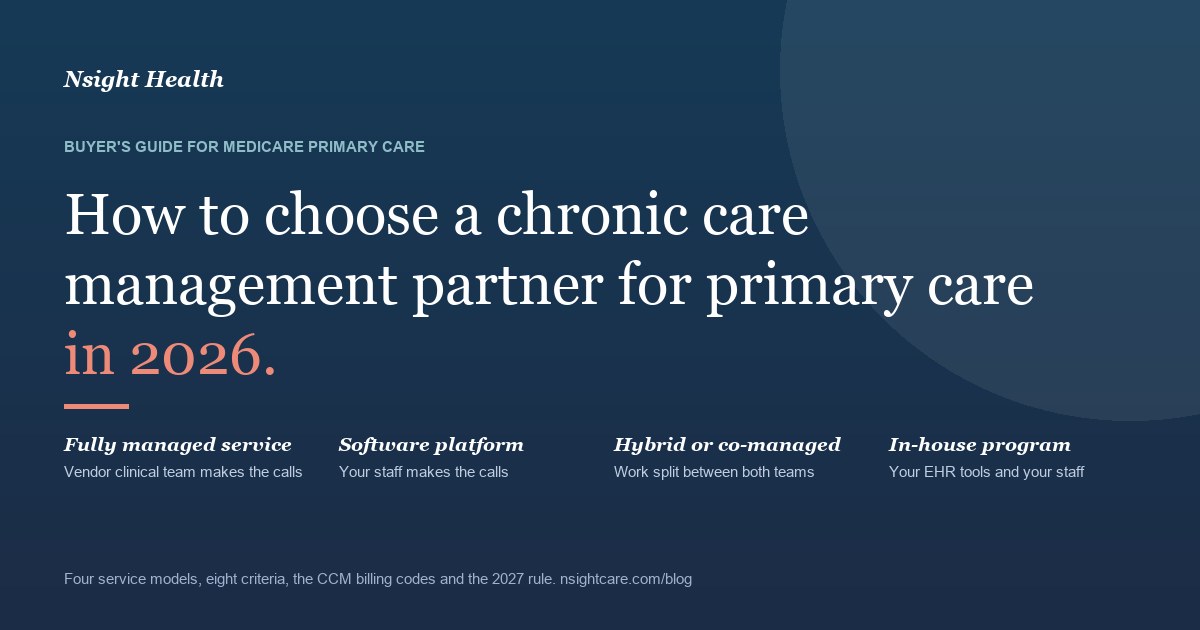
Instead of ranking vendors, here is how the four models differ. Use it to decide what kind of partner fits before you compare any names. For help choosing between care management programs themselves, see CCM vs PCM.
| Partner model | What you get | Who does the monthly care coordination | Best fit in primary care | Watch out for |
|---|---|---|---|---|
| Fully managed CCM service | Patient outreach and enrollment, a clinical team, care plans, time tracking, documentation and billing support | The vendor's clinical team, with escalation to your physicians | Practices that want CCM running without adding care coordinators | Confirm who the clinicians are, how you stay in the loop and how consent is collected |
| Software platform | Care plan templates, time tracking, patient lists, billing reports | Your own staff | Practices with employed nurses or medical assistants who have capacity | The calls and the documentation still land on your team |
| Hybrid or co-managed | Vendor staff handle part of the work, such as outreach or after-hours coverage, and your staff handle the rest | Shared | Practices that want to start outsourced and bring more in-house over time | Split time tracking, unclear ownership of each patient and double documentation |
| In-house program | Your EHR's tools plus your own staff and processes | Your own staff | Larger groups with dedicated care management teams | Hiring, training, coverage and audit readiness are all yours |
A note on a fifth option you may hear about: Advanced Primary Care Management (APCM) is a different Medicare billing pathway, not a vendor type. It can't be billed with CCM for the same patient in the same month. Our APCM guide explains when it fits.
The eight criteria that matter for Medicare primary care
1. The service model and who the clinicians work for
Ask: Who makes the monthly call, and who employs that person?
In a fully managed model the vendor's clinicians do the work under your direction. Ask for the credentials of the people on the phone and whether they operate as an extension of your practice, using the care plan and escalation steps you approve. CMS allows general supervision for clinical staff in care management, so the practitioner doesn't have to be in the room.
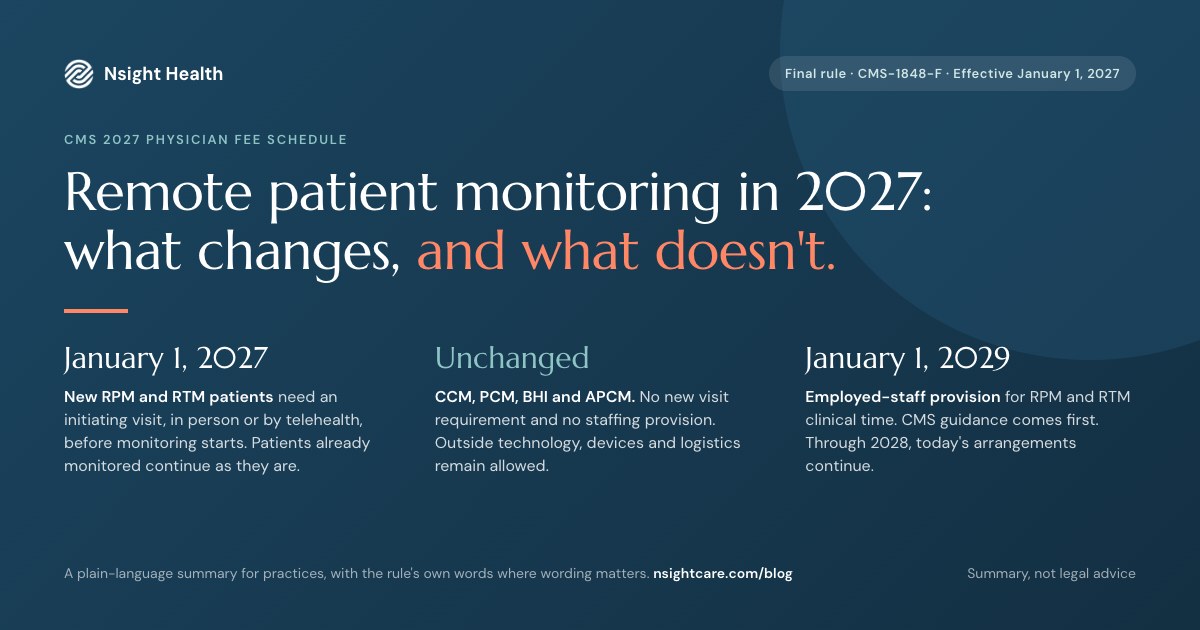
A word on 2029. CMS's employed-staff provision, which says RPM and RTM codes can't be billed when the clinical staff aren't direct employees of the practice, starts January 1, 2029 and applies to remote monitoring only. CCM, PCM, BHI and APCM aren't changed by the rule. If you plan to run RPM next to CCM, ask the partner how its remote monitoring model works in 2029. Our breakdown of the CMS 2027 final rule has the details.
Watch out: No clear answer on who actually calls your patients, and clinicians you never get to meet or review.
2. Care coordination staffing and continuity
Ask: What credentials, hours and languages does the team cover, and do patients speak to the same person each month?
CCM works when patients recognize the voice on the phone. Look for registered nurses and other licensed staff, a team that can reach patients in the languages your panel speaks, and a defined way to escalate a concern to your physicians. The program also requires 24/7 access to a care team member for urgent needs, so ask exactly how that works and who answers the phone at 11 p.m. Ask about caseload per nurse and staff turnover too, since both show up in how patients feel about the program.
Watch out: Rotating callers, no after-hours access and scripted calls that ignore what the patient said last month.
3. Eligibility, consent and patient communication
Ask: Who finds eligible patients, explains the program, gets consent and explains cost-sharing?
A Medicare patient qualifies with two or more chronic conditions expected to last at least 12 months that put them at significant risk of death, acute exacerbation, decompensation or functional decline. CCM also needs documented patient consent, including an acknowledgment of cost-sharing, and a provider visit within the 12 months before CCM starts. Ask who has the consent conversation and how it's recorded. A patient who knows why a nurse is calling and what it may cost is far less likely to be surprised later. Our post on why eligible patients say no covers the same dynamic for remote monitoring.
Watch out: Vague consent language, no plan for cost-sharing questions and outreach that sounds like a sales call.
4. The care plan and clinical workflow
Ask: How is the care plan built, who sees it and how does it reach my physicians?
CCM requires a comprehensive, patient-centered electronic care plan that is established, implemented and regularly monitored. A good partner starts with a risk assessment and the patient's own health goals, keeps the plan current and shares it with your team. Ask to see a sample plan and a sample monthly note. The initial comprehensive assessment and care planning can be billed once with HCPCS G0506, and its time doesn't count toward monthly CCM time.
5. Billing and CPT code support
Ask: Does the platform track time automatically, and what do you hand my billing team each month?
The codes you'll bill for CCM:
| CPT code | What it covers | Approx. 2026 national rate |
|---|---|---|
| 99490 | First 20 minutes of clinical staff time per month | $66 |
| 99439 | Each additional 20 minutes of clinical staff time, up to twice a month | $50 |
| 99491 | First 30 minutes personally provided by the physician or qualified health professional | $89 |
| 99437 | Each additional 30 minutes personally provided by the physician or qualified health professional | $63 |
| 99487 | Complex CCM, first 60 minutes of clinical staff time | $144 |
| 99489 | Complex CCM, each additional 30 minutes of clinical staff time | $78 |
The rates are approximate national averages and vary by locality; check the CMS Physician Fee Schedule look-up tool for yours. Three rules trip practices up. Only one tier of CCM can be billed per patient per month, so complex and non-complex codes can't be mixed. Only one practitioner can bill CCM for a patient in a given month. And CCM time can't overlap with time reported for other billable services such as RPM, BHI or PCM. A strong partner tracks time by date, staff member, activity and duration, and gives your billing team a monthly report so claims are accurate. See the CCM CPT codes guide for documentation and denial patterns.
On 2027: the final rule didn't change CCM. The small 2027 movement in 99490 is the conversion factor, not a CCM policy change. CMS asked questions about CCM and APCM in the rule but decided nothing, and the July 2027 proposed rule is the next place to watch.
Watch out: Manual time tracking, thin documentation and a vendor that can't tell you which tier a patient belongs in.
6. EHR integration and documentation
Ask: Which EHRs do you integrate with, and what shows up in the chart?
Integration ranges from notes written into the chart to a PDF dropped in as a document. Ask for a live look at what your physician sees after a CCM month, including the care plan and the time log, and what it costs to turn on. Our post on why EHR integration matters explains what to look for.
7. Alignment with RPM and your other programs
Ask: Can the same partner run RPM and CCM for the same patient, and keep the time separate?
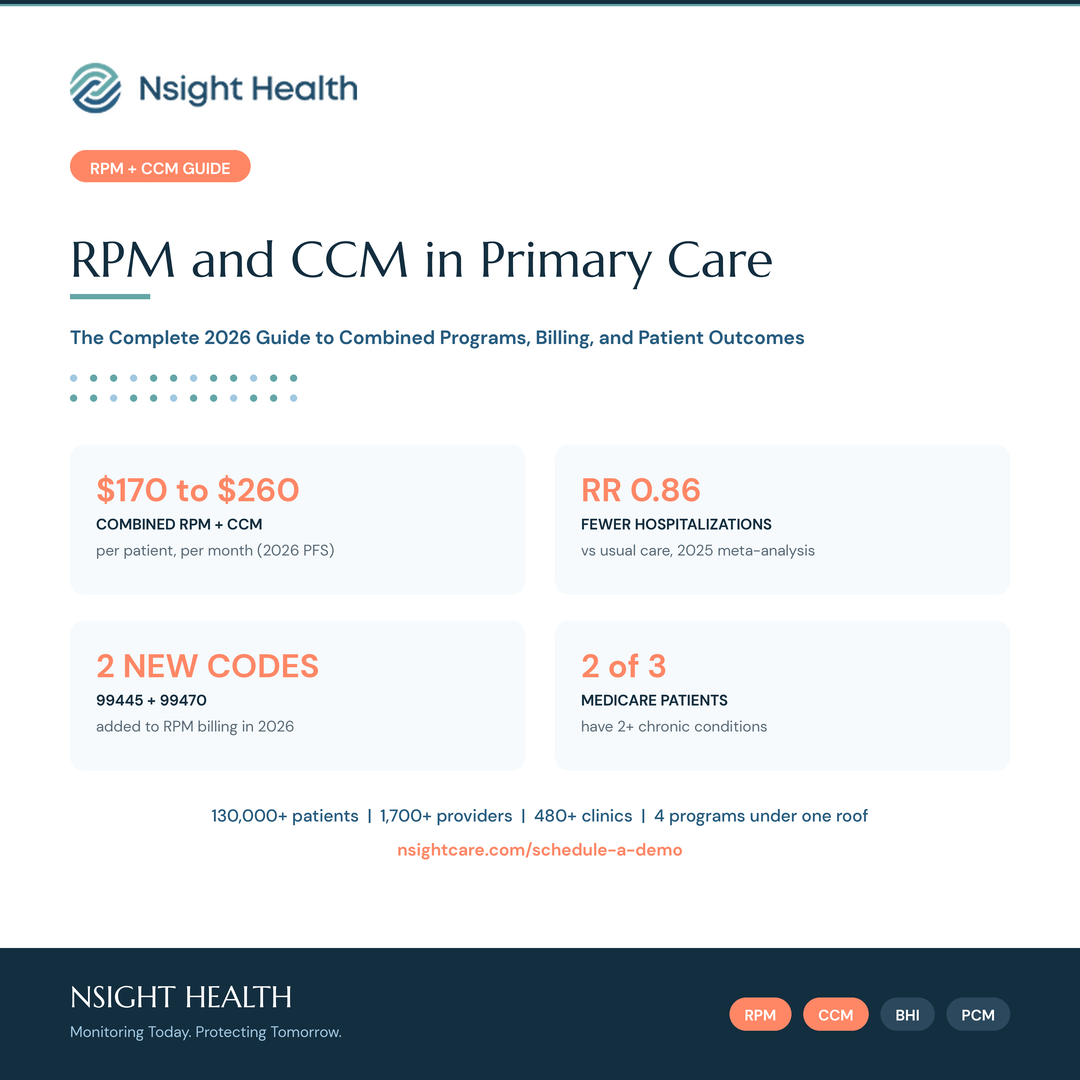
Medicare lets CCM and RPM be billed for the same patient in the same month when each program's time and documentation stay distinct. Patients with hypertension, diabetes or heart failure often benefit from both: daily readings from a connected device, and a nurse who calls to talk through what the readings mean. One partner running both can avoid two sets of calls, two consent conversations and two billing reports. It also helps with the choice between CCM and PCM for a patient whose care is driven by a single condition. Our combined RPM and CCM guide shows how the programs fit together.
Watch out: Two vendors calling the same patient, and time that gets counted twice.
8. Compliance, audit readiness and contract terms
Ask: Will you sign a Business Associate Agreement, how do you keep documentation audit-ready, and what am I committing to?
CCM moves protected health information every month. Look for HIPAA compliance, an independent security report such as SOC 2 Type II and a partner that will stand next to you in a review. Medicare oversight of remote care billing is increasing, so documentation should show what was done, by whom, when and for how long. Our post on navigating UPIC audits explains what reviewers look for. On terms, avoid long lock-ins before you've seen results, and ask whether fees depend on reimbursement.
Want to run these questions against your own Medicare panel? Schedule a demo and we'll walk through them with you.
Where Nsight fits
Nsight Health is a fully managed provider of chronic care management and remote patient monitoring. Its clinical team runs the monthly program for the practice. Here is what that looks like against the criteria above, based on what's published on nsightcare.com:
- Monthly work. A registered nurse makes a monthly phone call, starting with a risk assessment questionnaire and the patient's own health goals. Nsight's nurses also help schedule doctor appointments, provide education, support medication adherence and keep the patient accountable.
- Access. Patients get 24/7/365 text and call support.
- Staffing. A U.S.-based clinical team, including W2 registered nurses, LVNs and medical assistants. Nsight's published CCM page describes English and Spanish coverage and clinic-guided escalation processes, with the team operating as an extension of your practice.
- Documentation and billing. The platform time-stamps and records patient interactions, records clinical staff notes and generates billing reports. Nsight helps with billing details so the practice can generate clean claims, and the practice remains the billing entity.
- EHR integration. Integrates with cloud-based EHRs, with more than 50 EHR integrations overall.
- One partner for several programs. Chronic care management, remote patient monitoring, principal care management and behavioral health integration. Its remote monitoring was named Best Remote Patient Monitoring Solution of 2026 by MedTech Breakthrough.
- Compliance. HIPAA and SOC 2 Type II compliant.
- Terms. For remote patient monitoring, Nsight publishes that fees are tied to successful reimbursement with no upfront cost to the practice. Ask for the CCM terms in writing at your demo.
A pulmonologist put it this way on our site: "Nsight helped us expand chronic care delivery without over-extending our practice or our staff." (Dr. Geoff Koff, Pulmonologist) And a patient in the CCM program said: "I feel like someone is actually watching out for me between my doctor visits."
Who Nsight isn't the right fit for. If you already employ care coordinators with capacity and you only need software, a software platform may suit you better. If your billing practitioner wants to personally provide the time for 99491 and 99437, that time has to come from your physician or qualified health professional, not from a vendor's staff. APCM is a separate pathway that Nsight lists as coming soon. If you also want remote patient monitoring, our guide to choosing an RPM company covers that side.
For the full billing thresholds, qualifying conditions and a partner checklist, get the White Coat Guide to Chronic Care Management, and for the 2027 rule see the White Coat Guide to RPM and CCM in 2027 for primary care. To see how a program would work for your panel, schedule a demo.
Frequently asked questions
Who are the best chronic care management companies in the U.S.?
Instead of one ranking, think in four models: fully managed CCM services, software platforms, hybrid or co-managed arrangements and in-house programs. For a Medicare primary care practice, most choose between a fully managed service and a software platform, based on whether they have staff to make the monthly calls and document the time. Nsight Health is a fully managed provider. This guide doesn't rank vendors; it gives you the criteria to compare them.
What should I look for in a CCM partner for Medicare patients?
Look at who does the monthly work and who employs them, staffing and continuity, how consent and patient communication are handled, the care plan, billing and time tracking, EHR integration, alignment with RPM and audit readiness. Ask to see a sample care plan, a time log and a monthly billing report before you sign.
What does a CCM partner actually do each month?
A fully managed partner's clinical team contacts each enrolled patient, reviews the care plan and medications, helps with appointments and education, logs the time and documents each interaction, then gives the practice a report to bill from. The practice remains responsible for the billing and the clinical decisions.
What's the difference between full-service and software-only CCM?
A software-only vendor provides the platform and leaves the calls, care plans and documentation to your staff. A full-service vendor adds a clinical team and outreach so the program is run for you.
Which CPT codes cover chronic care management?
CPT 99490 and 99439 for clinical staff time, 99491 and 99437 for time personally provided by the physician or qualified health professional, and 99487 and 99489 for complex CCM. HCPCS G0506 covers the initial assessment and care planning. Only one tier can be billed per patient per month. Confirm current requirements with CMS and your billing team.
Does the practice or the vendor bill Medicare for CCM?
The practice stays the billing entity. A vendor helps run the program and prepares the documentation and billing report, and your practice submits the claims.
Can the same partner run CCM and remote patient monitoring?
Yes. Medicare allows CCM and RPM for the same patient in the same month when time and documentation stay separate. One partner running both can keep the calls, consent and billing in one place.
How do CCM, PCM and APCM differ?
CCM fits patients with two or more chronic conditions expected to last at least 12 months. PCM fits a single dominant condition expected to last at least three months. APCM is a bundled monthly payment that doesn't track minutes. CCM and PCM can't be billed for the same patient in the same month, and APCM can't be billed with CCM or PCM in the same month.
Does the 2027 CMS rule change chronic care management?
No. CCM, PCM, BHI and APCM weren't changed by the final rule. The initiating-visit requirement and the 2029 employed-staff provision apply to remote patient monitoring and remote therapeutic monitoring only. CMS asked questions about CCM and APCM but decided nothing, so watch the July 2027 proposed rule.
Do patients have to pay anything for CCM?
Medicare cost-sharing can apply, which is why consent must be documented and must include an acknowledgment of cost-sharing responsibilities. Ask any partner how it explains this to patients before they enroll.
Sources
CMS, "Calendar Year (CY) 2026 Medicare Physician Fee Schedule Final Rule (CMS-1832-F)," cms.gov.
CMS, Physician Fee Schedule Look-Up Tool, cms.gov/medicare/physician-fee-schedule/search.
Nsight Health, Chronic Care Management, Remote Patient Monitoring and CMS 2027 final rule pages, nsightcare.com.
Disclaimer: This article is provided for general informational purposes only and does not constitute legal, billing, clinical or financial advice. Coverage rules, supervision requirements and reimbursement policies change and vary by Medicare Administrative Contractor (MAC) and payer. Reimbursement figures are approximate national averages based on the 2026 Medicare Physician Fee Schedule and vary by locality. Providers are responsible for verifying current requirements and confirming the accuracy of any claims they submit. CPT is a registered trademark of the American Medical Association.