RPM and CCM in Primary Care: The Complete 2026 Guide to
Remote Patient Monitoring (RPM)

RPM and CCM in Primary Care: The Complete 2026 Guide to Combined Programs

RPM and CCM in primary care 2026 guide: combined remote patient monitoring and chronic care management billing codes, reimbursement, and patient outcomes

Most Medicare patients with two or more chronic conditions leave every office visit without a plan for what happens next. Blood pressure goes unmonitored for months. Weight creeps up between appointments. Glucose trends worsen before anyone notices. For primary care and multispecialty physician groups, the 2026 CMS Physician Fee Schedule Final Rule provides the billing infrastructure to close that gap permanently, and combining RPM and CCM is how the most effective practices are doing it.

This guide explains how remote patient monitoring and chronic care management work together to improve patient health outcomes and strengthen the healthcare revenue cycle in primary care. It covers how each service works, who qualifies, the 2026 medical billing codes that make concurrent billing more flexible, the clinical evidence behind remote monitoring, and what separates programs that succeed from those that never reach the patients who need them.

Key Takeaways
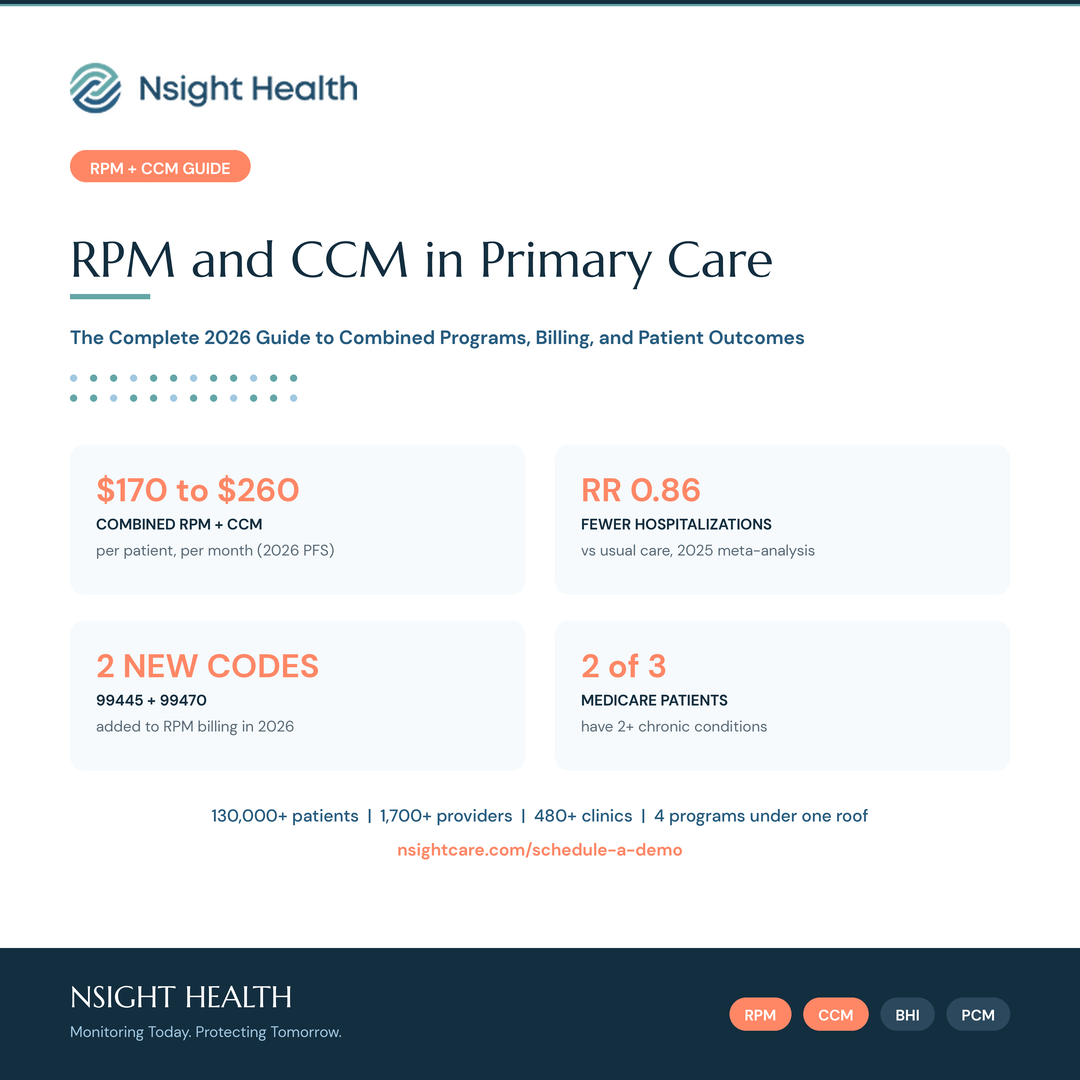
  • RPM and CCM can be billed concurrently under the 2026 CMS Physician Fee Schedule when time and documentation are kept distinct, generating approximately $170 to $260 per patient per month.
  • Two new 2026 RPM codes (99445 and 99470) capture revenue for lower-engagement months that previously paid nothing.
  • A 2025 meta-analysis across 40 randomized controlled trials associated RPM with reduced hospitalizations compared with usual care.
  • The clinical value comes from continuous monitoring paired with structured care coordination, not from either service alone.

What Are RPM and CCM Programs?

Remote Patient Monitoring: Clinical Overview

Remote patient monitoring uses FDA-cleared, cellular-enabled devices to capture patient vital signs continuously between office visits and transmit that data automatically to a clinical team. The ordering provider receives real-time physiologic data without requiring the patient to schedule an appointment, travel to a clinic, or interact with any technology beyond the device itself.

The most common RPM devices include cellular-enabled blood pressure monitors, weight scales, pulse oximeters, and blood glucose monitors. In each case, the device takes a reading and transmits it automatically over a cellular connection to the patient record and to the monitoring clinical team. No WiFi. No smartphone app. No Bluetooth pairing. The patient turns the device on and takes a measurement.

That simplicity matters. The Medicare population is predominantly 65 and older, and many patients in this demographic cannot reliably manage app downloads, WiFi troubleshooting, or Bluetooth pairing. Cellular-enabled, FDA-cleared devices remove the technology barrier between a patient and their physiologic data.

RPM patient eligibility requirements:

Qualifying conditions for RPM include hypertension, heart failure, Type 1 and Type 2 diabetes, chronic obstructive pulmonary disease, chronic kidney disease, atrial fibrillation, obesity, coronary artery disease, and asthma, among others. In most primary care panels with a chronic disease population, a significant share of active patients qualify. RPM works best when paired with a system for reviewing and acting on incoming data, which is precisely what chronic care management provides.

Chronic Care Management: Clinical Overview

Chronic care management covers non-face-to-face care coordination for Medicare patients with two or more chronic conditions expected to last at least 12 months or until death. Where RPM provides physiologic data, CCM provides the framework to act on it: monthly care coordinator touchpoints, care plan maintenance, medication reconciliation, specialist referral coordination, and patient education.

According to the Centers for Medicare and Medicaid Services, CCM is designed for the patient population most at risk of deterioration and hospitalization. Roughly two-thirds of Medicare beneficiaries have two or more chronic conditions, so the eligible population is substantial in virtually every primary care and internal medicine practice.

CCM patient eligibility requirements:

The distinction between the two services is direct: RPM monitors what is happening physiologically between visits, and CCM coordinates what the care team does in response. Together they create a continuous care loop rather than isolated episodes of in-person contact. For a deeper look at either program on its own, see our 2026 RPM CPT code guide and 2026 CCM CPT code guide.

Why Combine RPM and CCM?

Clinical Outcomes: The Case for Combined Programs

The clinical argument for combining the two services rests on a simple logic: monitoring without coordination misses interventions, and coordination without monitoring lacks the objective data to prioritize those interventions.

A 2025 systematic review and meta-analysis published in JMIR mHealth and uHealth found that, across 40 randomized controlled trials, remote patient monitoring was associated with a reduction in the proportion of hospitalizations compared with usual care (risk ratio 0.86, 95% CI 0.77 to 0.95). Cardiovascular disease represented the largest condition group in the analysis, and heart failure, COPD, and diabetes were among the most commonly studied conditions.

A 2023 report in the Journal of Medical Internet Research described a health system that implemented RPM for heart failure, COPD, and pneumonia patients after discharge and reported a decline in 30-day readmission rates from 14 percent to 6 percent. Results reflect a specific program and population; individual results vary.

The clinical mechanism is early detection. RPM data surfaces physiologic warning signs before they escalate. A care coordinator in a CCM program who sees a patient's weight rise three pounds over five days can initiate a medication review and a provider alert before a heart failure exacerbation requires an emergency visit. That kind of intervention is only possible when continuous monitoring is paired with structured care coordination. A 2025 report in the Journal of Medical Internet Research on the state of RPM for chronic disease management in the United States found increasing patient acceptance, improved adherence to care plans, and favorable impacts on care quality.

Practice Efficiency and Revenue Cycle Impact

Once the clinical case is established, the operational and financial case follows. The opportunity in most practices is not a shortage of eligible patients. It is the reverse: the eligible base is large, and most of it never gets activated because the operational lift of outreach, consent, device delivery, education, and ongoing engagement exceeds what a busy clinical staff can sustain.

Consider the size of that base. Because roughly two-thirds of Medicare beneficiaries carry two or more chronic conditions, a panel of 500 Medicare patients commonly includes 200 to 300 who qualify for combined RPM and CCM. Every one of those patients who is not enrolled represents both a gap in continuous care and unrealized recurring revenue. The practices that benefit most are the ones that activate the largest share of that existing base, not the ones that simply have more patients.

On the revenue side, combined RPM and CCM services generate approximately $170 to $260 per patient per month under the 2026 CMS Physician Fee Schedule, depending on device transmission days, management time, and care coordination time. As an illustration, a practice with 100 enrolled patients on a combined program at approximately $220 per patient per month represents approximately $22,000 in monthly recurring revenue, or approximately $264,000 annually, without adding office visits or increasing physician time. The recurring nature of this revenue is what makes it valuable to the healthcare revenue cycle: it is predictable, monthly, and tied to care the practice is already responsible for delivering.

Can You Bill RPM and CCM Together?

The CMS Answer: Yes, With Conditions

The 2026 CMS Physician Fee Schedule Final Rule allows concurrent billing of RPM and CCM for the same patient in the same month. Time must be tracked separately for each service, and no clinical time may be counted toward both RPM management and CCM in the same billing period.

This distinction is practical, not punitive. RPM management time (CPT 99457 or 99470) covers reviewing remote monitoring data and communicating about that data with the patient or caregiver. CCM time (CPT 99490 or 99439) covers care coordination: care plan updates, medication reconciliation, specialist coordination, and general care management. These are distinct clinical activities, and CMS treats them as such. Practices that capture both services for eligible patients can generate approximately $170 to $260 per patient per month in recurring revenue.

What Cannot Be Billed Together

Not all care management codes are concurrent-billing-compatible. Understanding the mutual exclusivity rules prevents compliance issues.

Documentation Requirements for Concurrent Billing

CMS requires at least one interactive communication with the patient or caregiver per calendar month for the RPM treatment management codes. Consult current CMS guidance and your Medicare Administrative Contractor for the specific requirements that apply to your practice.

2026 Medical Billing Codes for Combined RPM and CCM Programs

RPM Code Breakdown: What Changed in 2026

The 2026 CMS Physician Fee Schedule Final Rule added two new RPM CPT codes that close a long-standing gap in the program's billing structure. Both expand revenue capture for patients with lower engagement than the previous thresholds required.

CPT CodeDescription2026 National Average
99453Initial device setup and patient education (one-time per device)approximately $22
99454Device supply and automated data transmission, 16 to 30 days per monthapproximately $52
99445Device supply and automated data transmission, 2 to 15 days per month (new 2026)approximately $52
99457RPM treatment management, first 20 minutes per monthapproximately $52
99458RPM treatment management, each additional 20 minutesapproximately $41
99470RPM treatment management, 10 to 19 minutes per month (new 2026)approximately $26

Rates are national averages from the 2026 CMS Physician Fee Schedule Final Rule. Actual reimbursement varies by geographic location (GPCI), individual payer contracts, and Medicare Administrative Contractor (MAC) policies.

CPT 99445 (new 2026): Before 2026, a patient who transmitted 15 days of readings in a month generated nothing in device supply revenue, because the 99454 threshold required 16 days. CMS created 99445 to address that gap. A patient transmitting 2 to 15 days of data now generates approximately $52 in device supply revenue, the same as 99454 for 2026.

CPT 99470 (new 2026): Previously, 99457 required 20 minutes of management time to bill, and patients who needed only 10 to 19 minutes generated nothing. CPT 99470 covers 10 to 19 minutes at approximately $26 and is mutually exclusive with 99457 in the same month.

CCM Code Breakdown

CPT CodeDescription2026 National Average
99490CCM, non-complex, first 20 minutes per month (clinical staff)approximately $66
99439CCM, non-complex, each additional 20 minutes (clinical staff)approximately $50
99491CCM, first 30 minutes provided personally by a physician or QHPapproximately $89
99437CCM, each additional 30 minutes provided by a physician or QHPapproximately $63
99487Complex CCM, first 60 minutes per monthapproximately $144
99489Complex CCM, each additional 30 minutesapproximately $78

The most commonly billed CCM codes are 99490 (first 20 minutes, approximately $66) and 99439 (each additional 20 minutes, approximately $50). A patient receiving 40 minutes of non-complex care coordination per month generates approximately $116 in CCM revenue. A practice may bill only one tier of CCM for a given patient in a given month; non-complex and complex codes cannot be reported together for the same patient in the same month.

Combined Monthly Revenue Example

For a patient on a full combined RPM and CCM program in a single month:

CodeActivity2026 National Average
99454 or 99445Device supply and transmissionapproximately $52
99457 or 99470RPM treatment managementapproximately $52 or $26
99458Additional RPM management time (if applicable)approximately $41
99490CCM, first 20 minutesapproximately $66
99439CCM, additional 20 minutes (if applicable)approximately $50
Monthly totalCombined RPM and CCMapproximately $170 to $260

Dollar amounts are illustrative national-average estimates and vary by locality and payer. For program-level modeling, our team can walk through your panel and payer mix during a scheduled demo.

Clinical Evidence for Combined Remote Monitoring

The evidence base for RPM in chronic disease management has grown substantially since 2020, with the strongest data concentrated in cardiovascular disease, heart failure, COPD, and diabetes.

The 2025 meta-analysis in JMIR mHealth and uHealth reviewed 40 randomized controlled trials published between 2017 and 2024 and associated RPM with a reduced proportion of hospitalizations compared with usual care (risk ratio 0.86, 95% CI 0.77 to 0.95). The authors rated evidence certainty as low, reflecting the heterogeneity of RPM program structures studied rather than a negative finding. The 2024 JMIR Formative Research study of high-risk postdischarge patients found that home telemonitoring with clinical follow-up may reduce hospital readmissions and emergency department visits, combining device-based monitoring with structured weekly clinical contact in a design that parallels a combined RPM and CCM program.

Strongest evidence by condition:

The Nsight Health Approach to RPM and CCM

The gap between what an RPM program promises and what it delivers usually comes down to one variable: who runs the program. A software-only platform provides a dashboard, device management tools, and billing documentation support, then leaves the practice responsible for enrolling patients, educating them, managing engagement, triaging readings, and handling billing. That operational load is the reason so much of a practice's eligible base never gets activated.

Nsight Health operates as a fully managed program. A dedicated enrollment team contacts patients, explains the program, secures consent, delivers devices, and educates patients on use. A U.S.-based clinical team employed by Nsight Health reviews incoming data and triages alerts to the ordering provider around the clock. Billing support is included. The practice provides the physician order and the patient panel. Nsight runs the clinical program, and the practice bills, collects, and grows.

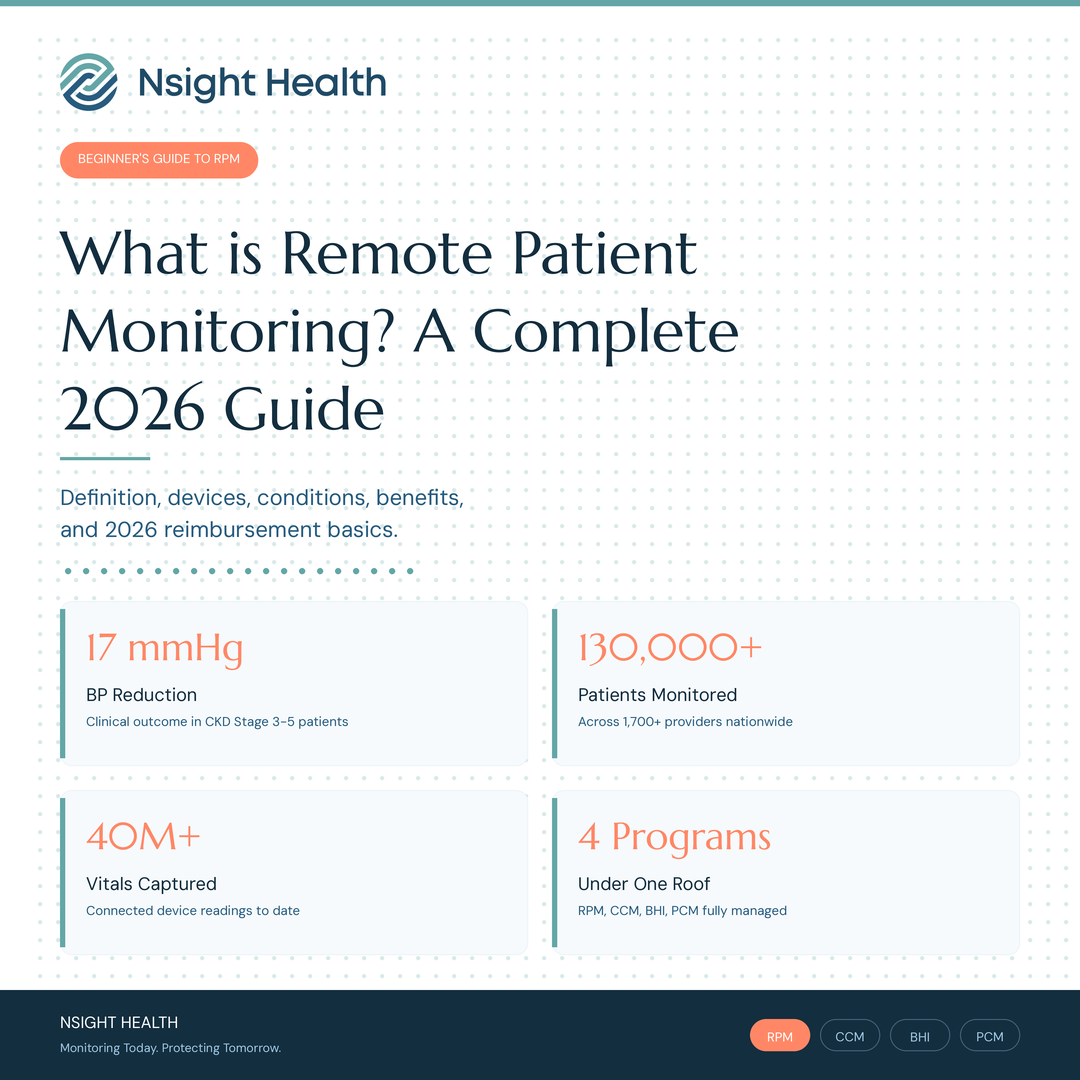
Nsight Health supports more than 130,000 patients across 1,700+ providers and 480+ clinics, with more than 40 million vitals monitored. That operational scale is what allows the clinical team to manage combined programs reliably at high volume.

Nsight delivers four programs under one roof, RPM, CCM, behavioral health integration, and principal care management, so a practice can layer the right services for each patient without managing multiple vendors. The cellular-enabled, FDA-cleared devices are central to engagement: patients who cannot use a smartphone app or configure a WiFi device can still participate, which matters for a Medicare population where technology barriers are a primary driver of low engagement.

Implementation Guide: Starting a Combined RPM and CCM Program

Step 1: Identify and Stratify Eligible Patients

Start with your current Medicare panel. Patients eligible for CCM (two or more chronic conditions lasting 12 or more months) are also strong RPM candidates when they have a monitorable physiologic parameter: blood pressure, weight, glucose, or oxygen saturation. Prioritize the highest-risk segment first: patients with a hospitalization or ED visit in the past 90 days, patients with poorly controlled disease, patients managing three or more chronic conditions, and patients who generate frequent unscheduled calls to nursing staff.

Step 2: Secure Physician Orders and Patient Consent

RPM requires a physician order before the device is provided, with patient consent documented beforehand. CCM requires an initiating visit for patients new to the practice or not seen within the past 12 months, and consent documented in the record. Where possible, build a workflow that captures both RPM and CCM consent in a single patient interaction.

Step 3: Enroll Patients and Deliver Devices

This is where most self-managed programs lose momentum. Calling patients, explaining the program, coordinating device delivery, and educating patients on use requires consistent outreach that clinical staff often cannot sustain alongside primary patient care. A fully managed program handles outreach, device delivery, and education through a dedicated enrollment team, which is how a far larger share of the eligible base actually gets activated. All devices must be FDA-cleared and capable of automated data transmission over HIPAA-compliant, secure infrastructure.

Step 4: Monitor Remotely and Triage Alerts

Once patients are enrolled, the ongoing management infrastructure determines both clinical outcomes and billing completeness. For RPM, clinical staff review incoming readings against clinically defined thresholds, evaluate readings outside threshold, contact the patient when needed, and triage significant findings to the ordering provider. For CCM, care coordinators contact enrolled patients monthly to review care plan adherence, medication questions, symptom changes, and specialist coordination. RPM management time and CCM time must be tracked in separate documentation, because a shared time entry cannot count toward both services.

Step 5: Bill Accurately Using 2026 CPT Codes

At the end of each billing month, confirm documentation before submitting claims:

Frequently Asked Questions

Can RPM and CCM be billed together for the same patient in the same month?
Yes. CMS allows concurrent billing of RPM and CCM under the 2026 Physician Fee Schedule. Time must be tracked separately for each service, and no time may be counted toward both programs in the same billing period. A patient receiving both services can generate approximately $170 to $260 per month in combined billing.

How many patients in a typical primary care practice qualify for both RPM and CCM?
Because roughly two-thirds of Medicare beneficiaries have two or more chronic conditions, a panel of 500 Medicare patients commonly includes 200 to 300 who qualify for combined RPM and CCM. Patients with diabetes, hypertension, and heart failure are among the most common dual-qualifying conditions.

What chronic conditions qualify patients for RPM?
RPM requires at least one chronic condition, or an acute condition lasting 90 or more days, plus a physician order and patient consent. Common qualifying conditions include hypertension, diabetes (Type 1 and Type 2), heart failure, COPD, chronic kidney disease, atrial fibrillation, obesity, and coronary artery disease.

What is the difference between CPT 99445 and 99454?
Both cover device supply and data transmission for RPM. CPT 99445 (new in 2026) applies when the patient transmits data for 2 to 15 days in a calendar month; CPT 99454 applies for 16 to 30 days. They cannot be billed in the same month, and the number of transmission days determines which code applies.

What is the difference between CPT 99470 and 99457?
Both cover RPM treatment management time. CPT 99470 (new in 2026) applies when management time is 10 to 19 minutes in a calendar month; CPT 99457 applies once management time reaches 20 or more minutes. They are mutually exclusive, so bill one or the other based on documented minutes.

What does fully managed RPM mean compared with a software-only platform?
A software-only platform provides the technology but leaves enrollment, device delivery, education, engagement, alert review, and billing to the practice. A fully managed program such as Nsight Health handles those functions through a dedicated enrollment team, a U.S.-based clinical monitoring team, and billing support, which is what allows a practice to activate a much larger share of its eligible patient base.

How do I track time separately for RPM and CCM billing?
Maintain distinct documentation for each service. RPM management documentation should record date, minutes spent, activities performed, and whether interactive communication occurred. CCM documentation should record date, minutes spent, activities performed, and method of patient contact. No single time entry should appear in both records.

Does Medicare Advantage cover RPM?
Traditional Medicare (Parts A and B) provides comprehensive RPM coverage under the 2026 Physician Fee Schedule. Medicare Advantage coverage varies by plan, and some plans apply additional restrictions, so practices billing Medicare Advantage patients should verify coverage with the individual plan before enrolling. The most consistent RPM reimbursement is through traditional Medicare fee-for-service.

How do RPM and CCM improve patient health outcomes in primary care?
RPM surfaces physiologic changes between visits, and CCM provides the care coordination to act on them. Combined, they enable earlier intervention, better medication management, and stronger care plan adherence. Published evidence associates remote monitoring with reduced hospitalizations across several chronic conditions, with the most consistent signal in heart failure.

Conclusion: A Continuous Care Model for Primary Care

For primary care and multispecialty groups, combining RPM and CCM converts episodic visits into a continuous care model: continuous physiologic monitoring paired with structured monthly coordination. The clinical case rests on earlier intervention and reduced hospitalizations. The operational case rests on activating an eligible base that is already large in most Medicare panels. The financial case rests on predictable, recurring, concurrently billable revenue that strengthens the healthcare revenue cycle. To explore how a combined program would work in your practice, schedule a demo with Nsight Health.

Works Cited

Centers for Medicare and Medicaid Services. "Physician Fee Schedule." CMS.gov, 2025, www.cms.gov/medicare/payment/fee-schedules/physician.

"Remote Patient Monitoring for Patients With Noncommunicable Diseases: Systematic Review and Meta-Analysis." JMIR mHealth and uHealth, 2025, mhealth.jmir.org/2025/1/e68464.

"Home Telemonitoring of High-Risk Patients Following Hospital Discharge." JMIR Formative Research, 2024, formative.jmir.org/2024/1/e53455.

"State of Remote Patient Monitoring for Chronic Disease Management in the United States." Journal of Medical Internet Research, 2025, www.jmir.org/2025/1/e70422.

"Remote Patient Monitoring and Hospital Readmissions." Journal of Medical Internet Research, 2023, www.jmir.org/2023/1/e42335.

This article is for educational and informational purposes only and does not constitute legal, billing, coding, or medical advice. CPT codes and reimbursement rates are subject to annual CMS updates, and reimbursement varies by geographic locality, payer, and Medicare Administrative Contractor. Nsight Health does not guarantee specific reimbursement, revenue, or clinical results; individual results vary. Practices should consult a qualified billing compliance specialist or legal counsel for program-specific guidance and verify all rates against the current CMS Physician Fee Schedule and their MAC. CPT is a registered trademark of the American Medical Association.
Remote Patient Monitoring (RPM)Chronic Care Management (CCM)
Fully managed remote care

See what a program would look like for your patients

A 30-minute walkthrough with our team: which programs fit your panel, what the clinical workflow looks like and what your practice would need to do. Nothing to buy up front.

Michael Ciullo

Founder, Chief Executive Officer

Michael Ciullo is a self-made serial entrepreneur who has built numerous businesses within healthcare technology and healthcare services. With no formal education and from humble beginnings, Michael started his career in B2B SaaS sales and after four years branched out on his own to build his first revenue cycle management company.

In 2015, Michael started Nsure Healthcare Services, a healthcare technology firm dedicated to streamlining medical billing departments, which was awarded by the Inc500 as being one of the fastest growing companies in the United States. Having never raised capital, Michael reinvested the earnings from his first two ventures and built Nsight Health which has become the fastest growing remote care company in the United States.

Today, Michael, his companies, and his teams are servicing hundreds of medical practices, thousands of providers, and millions of patients across the country with the help of his incredibly talented leadership teams and trusted advisors.

Michael Ciullo

Amber Sanchez

Chief Operating Officer

Amber Sanchez is a dynamic and seasoned product and operations executive with over a decade of experience in the SaaS industry. Currently serving as the Chief Operating Officer, Amber is recognized for her ability to align product innovation with business growth, delivering exceptional value to customers and stakeholders. Her leadership is marked by a strategic focus on building high-performance teams, fostering a culture of empowerment, and ensuring that every product meets the evolving needs of its users.

Amber’s career journey includes pivotal roles such as Chief of Staff, SVP of Operations and VP of Product Strategy, where she played a key role in driving operational excellence and launching innovative products that significantly enhanced customer satisfaction and retention. Her deep understanding of both the technical and human elements of product development allows her to seamlessly bridge the gap between technology and user experience.

A Certified ScrumMaster (CSM) and Certified Scrum Product Owner (CSPO), Amber brings a structured yet flexible approach to product management. She is passionate about leveraging agile methodologies to ensure rapid, iterative product delivery that exceeds customer expectations. Her commitment to continuous improvement and user-centric design has earned her widespread recognition, including being named one of the “Top 25 Most Influential Young Professionals” by Gen XYZ in 2019, and one of the “Top 3 Emerging Leaders of the Year” at the APEX Awards in 2018.

Amber Sanchez

Mark Reynolds

Chief Financial Officer

Mark Reynolds is an accomplished financial leader with a decade-long track record in steering strategic decisions through meticulous forecasting and data-driven insights. Mark is renowned for crafting innovative financial strategies that optimize profitability and shareholder value, he has excelled in high-growth businesses by streamlining processes and fostering cross-functional collaboration. Mark’s expertise in financial acumen, risk management, and compliance ensures sustained financial health and regulatory adherence.

Mark’s forte lies in driving excellence across financial planning, analysis, reporting, and audit functions, facilitating informed decision-making and enhancing organizational performance. Proficient in global market navigation, cost reduction initiatives, and instilling a culture of financial discipline, he has successfully achieved corporate objectives. Mark’s technical prowess spans Deloitte audit methodology, IFRS, GAAP, SOX, International Audit Standards, and advanced Excel skills.

Mark holds a Chartered Accountant (South Africa) designation and pursued Bachelor of Commerce degree specializing in Accounting, Tax, Finance, Auditing, and related fields from the University of Johannesburg.

Mark’s professional journey includes impactful roles at Deloitte South Africa, Webhelp South Africa as Finance Director, and Webhelp North America as Senior Vice President of Finance.

Mark Reynolds

Mark Brennan

Chief Information Security Officer

Mark Brennan is a technology and security executive with extensive experience leading cybersecurity, compliance, secure AI, infrastructure, platform engineering, data engineering, and application development initiatives across healthcare and SaaS environments. Throughout his career, he has built and led high-performing security and engineering organizations responsible for information security, governance, risk management, cloud operations, DevOps, enterprise platforms, identity and access management, and large-scale technology modernization initiatives driving transformation within complex and highly regulated businesses. His work has focused on strengthening security posture, improving operational resilience, enabling scalable software delivery, and aligning technology and security strategy with broader business objectives to enable organizations to innovate and scale securely in rapidly evolving markets.


Over the years, Mark has led initiatives involving SOC 2, HIPAA, HITRUST, Sarbanes-Oxley (SOX) IT controls, NERC Critical Infrastructure Protection (NERC CIP) regulated systems, and NIST-informed security practices. He has a particular focus on secure AI adoption, AI governance, and securing modern AI-enabled software development and cloud environments within regulated industries. Known for bridging the gap between engineering, security, operations, and executive leadership, Mark is passionate about building practical, forward-looking programs that strengthen trust, accelerate innovation, and create long-term organizational impact. Mark holds a Bachelor of Science in Computer Systems Engineering from University of Massachusetts Amherst.

As Chief Information Security Officer at Ciullo Inc., Mark leads the organization’s information security, governance, risk, compliance, and secure AI strategy with a focus on protecting sensitive data, supporting innovation at scale, and building resilient systems that enable long-term organizational growth.

Mark Brennan - Chief Information Security Officer at Nsight Health

Michael Evans

Executive Vice President, Patient Experience

Michael Evans is a dynamic and results-driven call center transformation leader with over two decades of experience in elevating operational performance through strategic process optimization, cutting-edge technology, and data-driven insights. Renowned for his ability to manage and scale global operations, Michael excels at enhancing both customer and agent experiences by challenging conventional practices, streamlining workflows, and consistently achieving significant improvements in customer satisfaction, operational efficiency, and cost reduction.

As an expert in business intelligence, Michael integrates workforce management, performance analytics, and strategic planning to drive transformative change. His passion for continuous improvement and innovation has been the driving force behind the creation of highly efficient, multi-channel contact center operations, including inbound and outbound voice as well as omni-channel environments. Michael’s leadership is marked by a relentless focus on measurable outcomes, making him an invaluable asset in delivering exceptional results that directly impact the bottom line.

Mike Evans

Stacey Ramos

Senior Vice President, Human Resources

Stacey has over 20 years of experience in HR leadership roles across various industries, with a proven track record of elevating the role of HR as a strategic partner and a catalyst for organizational growth and
transformation. Stacey’s core competencies include operations and business management, talent and performance management, organizational development, and culture and employee engagement. She has a supportive and collaborative management style, with strong business acumen and analytical skills.


Stacey’s focused on creating and executing innovative HR solutions that align with Nsight’s core strategies and processes, and drive results at all levels. She is passionate about finding and developing talent, fostering a diverse and inclusive culture, and enabling a high-performance and agile environment. Her mission is to empower our employees and enhance our performance and reputation as a trusted and respected partner for our clients.

Stacey Ramos

Joshua Higgins, RN

Vice President, Clinical Operations

Josh Higgins has joined the Nsight team as a highly skilled and innovative Clinical Operations leader, bringing over a decade of Nursing Leadership experience. He stepped into the Digital Healthcare arena in 2021, where he took charge of Clinical Operations for Optum Virtual Care. In this role, Josh spearheaded the development of the virtual care team, establishing key processes and protocols. He also worked closely with the product team as a clinical advisor to ensure seamless integration of clinical practices and technology. Under his leadership, Optum Virtual Care rapidly expanded to serve over 500,000 patients annually across all 50 states and Washington D.C.

During his time at Optum, Josh co-developed the Virtual Practice Health and Safety tool, which became a standard across all Optum Care Virtual business lines. His commitment to patient safety and quality care earned him the prestigious Sages of Clinical Services award in 2022, a recognition awarded to the top clinicians among over 57,000 licensed professionals at United Health Group. Additionally, he served as a panelist for Optum Health Education’s Digital Health series, focusing on how integrating multidisciplinary care teams can enhance patient and provider experiences and improve outcomes. Most recently, he has taken on a consulting role for Optum’s Virtual Medical Weight Loss Program, which transitioned into a permanent position leading a multidisciplinary clinical team.

Before his time at Optum Virtual Care, Josh was an Area Manager of Clinical Operations at MedExpress Urgent Care, overseeing multiple facilities on the East Coast and in Texas. During the peak of the COVID pandemic in 2020, he played a crucial role in establishing and managing some of the first outdoor testing sites in New Jersey, actively engaging in patient care through specimen collection and testing.

Josh’s unwavering dedication to quality care and enhancing the patient experience perfectly aligns with Nsight’s mission to innovate remote care solutions, helping patients live longer, healthier lives.

Joshua Higgins, RN

Taresa Bernard

Vice President, Operations

Taresa Bernard is a seasoned operations leader with over 15 years of experience driving cross-functional efficiency and execution in fast-paced, high-growth industries. As Vice President of Operations at Nsight, Taresa leads strategic initiatives that improve outcomes for patients, providers, and internal teams alike.

Throughout her career, Taresa has consistently delivered measurable improvements in utilization, customer satisfaction, and operational scalability. She is known for her structured approach to project execution, her ability to build and empower high-performing teams, and her strong cross-departmental collaboration. Her expertise spans agile methodologies, KPI frameworks, change management, and operational strategy.

Taresa holds a Bachelor of Science in Psychology from Colorado State University and is a certified Professional Scrum Master (PSM I). She is passionate about streamlining complex workflows to better serve both patients and care teams, and she brings a thoughtful, people-first mindset to everything she builds.

Taresa Bernard

John Eagle

Vice President, Revenue Cycle Management

John Eagle is a revenue cycle executive who has spent his career at the intersection of operations and technology, translating complex billing workflows into scalable automation systems and building the infrastructure that turns underperforming revenue cycles into high-functioning ones.

Currently serving as Vice President of Revenue Cycle Management, John is recognized for his ability to bridge the gap between billing operations and the technology teams that build the systems behind them. His leadership is marked by a hands-on approach to automation and a deep commitment to building revenue cycle operations that deliver consistent, measurable results for the providers they serve.

John’s career spans revenue cycle leadership across Medicaid, Medicare, Medicare Advantage, Veterans Affairs, and managed care environments, with additional depth in ACO value-based care. His experience across these programs has given him a comprehensive understanding of the payer landscape and the operational complexity that comes with it.

A proud Baylor Bear, John holds four HFMA certifications: Certified Healthcare Financial Professional (CHFP), Certified Specialist in Business Intelligence (CSBI), Operational Excellence, and Business of Health Care. He is passionate about leveraging technology to elevate what revenue cycle teams can accomplish, building operations where automation handles the routine so people can focus on the work that truly requires human judgment.

John Eagle - Nsight Health Revenue Cycle Management

Marc Miranda

Vice President, Business Development

Marc Miranda partners with healthcare organizations to design and implement care programs that deliver measurable outcomes — reducing unnecessary utilization, improving chronic disease management, and shifting providers toward reimbursement models built on value rather than volume.

Before moving into partnership development, Marc worked inside the provider ecosystem across FQHCs, outpatient physician groups, and health IT — giving him firsthand fluency in the clinical, financial, and compliance pressures that determine whether a care program succeeds or stalls.

At Nsight Health, he works alongside physician groups, health systems, aligned healthcare vendors and care teams to build RPM and CCM programs that are operationally sustainable and financially aligned with how modern healthcare is being rewarded.

Marc holds a BA in Communications from the University at Albany, an MBA from Western Governors University, and a Certified Healthcare Financial Professional (CHFP) designation from HFMA.

Marc Miranda Vice President of Business Development at Nsight Health

Carrie Metcalf

Vice President, Finance

Carrie Metcalf is a senior finance executive with over 18 years of experience in accounting and financial operations, known for building scalable finance functions and driving strategic growth in complex, high-growth environments. Before joining Ciullo Inc., she founded an outsourced accounting services firm where she partnered with organizations to deliver financial clarity, operational efficiency, and data-driven decision support.

Now in her fourth year with the organization, Carrie leads all customer-facing finance functions across the Ciullo family of companies, including Nsight Health and Nsure — organizations delivering innovative healthcare technology and revenue intelligence solutions that improve patient outcomes, optimize revenue capture, and streamline the end-to-end financial and clinical lifecycle.

In this role, she develops high-performing finance teams and drives accountability against key departmental KPIs spanning revenue performance, cash flow optimization, and operational efficiency. Carrie positions finance not only as a strategic business partner, but as a critical touchpoint in the customer experience — aligning financial processes with client needs to enhance transparency, responsiveness, and trust throughout the customer journey.

Carrie oversees financial strategy, client financial operations, and cross-functional alignment, playing a central role in scaling processes, improving performance, and supporting sustainable growth across the organization. She is recognized for her ability to translate complex financial data into clear, actionable insights that drive measurable results.

Carrie holds a Master of Accounting and Financial Management and brings a unique combination of technical expertise, entrepreneurial leadership, and a client-first mindset.

Carrie Metcalf, Vice President, Finance at Nsight Health

Isabella Barbera, CPA

Financial Controller

Isabella Barbera, CPA is a seasoned financial executive with over 25 years of experience spanning public accounting, corporate finance, and operational leadership, known for building high-performing finance teams, strengthening internal controls, and driving measurable efficiency across complex and evolving organizations. Before joining NSight Health, she built a distinguished career across both public and private sectors — serving as a Partner at regional CPA firms, founding her own accounting and advisory practice, and stepping into controller and CFO roles across industries including manufacturing, technology, healthcare, and real estate.

Now in her second year with the organization, Isabella serves as Group Financial Controller within the Ciullo family of companies, including Nsight Health and Nsure — organizations delivering innovative healthcare technology and revenue intelligence solutions that improve patient outcomes, optimize revenue capture, and streamline the end-to-end financial and clinical lifecycle.

In this role, Isabella brings a hands-on, ownership-driven approach to financial operations — implementing scalable processes, enhancing internal controls, and delivering the financial clarity that leadership needs to make confident, data-driven decisions. Her background in both public accounting and corporate finance gives her a uniquely broad perspective, allowing her to align technical rigor with strategic business objectives.

Isabella holds a Master of Taxation and a Bachelor of Science in Accounting from Florida Atlantic University, and has held her Certified Public Accountant license since 2003. She brings a rare combination of technical depth, entrepreneurial experience, and an unwavering commitment to operational excellence.

Isabella Barbera, CPA Financial Controller at Nsight Health

Martin Sances

General Counsel

Martin Sances is an experienced business attorney with an almost 30-year career primarily as an in-house attorney and general counsel to public and privately held companies. His past clients include companies in the fields of healthcare and technology, finance and capital management, solar and renewable energy, autonomous vehicles and transportation, insurance, educational and leadership training, temporary staffing and technology services, roofing and construction and facilities services. He is extremely skilled in contract drafting, raising capital, M&A, corporate formation and governance, negotiation, litigation management and arbitration.

Martin Sances

Ronald Geraty, MD

Advisor

Dr. Ronald Geraty is an entrepreneur with expertise in technology-enabled healthcare services. He is known for founding, developing, and transforming multiple healthcare companies over his professional career.  Importantly, his companies have helped to change the delivery of care to meet the Triple Aim of the Institute of Medicine.  Currently, he serves on the board of Ideal Option, a Varsity Healthcare Partners Company that does Medication Assisted Treatment across the Pacific Northwest.  Additionally (and outside of Varsity), he is Chairman of the Board and an advisor at Aduro (Redmond, WA), Chairman at Podimetrics (Somerville, MA) and an advisor to JumpStartMD, a Bay Area health and weight management company.  Most recently, he has joined the Advisory Board of nSight Health, a remote patient monitoring company.  

Dr. Geraty began his career as a physician with a specialty in child and adolescent psychiatry in private practice and academia (Harvard Medical School). Subsequently, serving in roles including positions of CEO, Board Member, and Executive Chairman, he led companies in psychiatry (Monarch Health sold to Lutheran General Healthcare and Assured Health which was eventually transformed into Merit Behavioral Care sold to Magellan); radiology (American Imaging Management now owned by Anthem); cardiology and other chronic diseases (Alere Medical sold to Inverness Medical which renamed itself Alere and is now owned by Optum); diabetes (Sanare), and dermatology (DermOne) and more recently, AxisPoint Health, a population health company focused on the Medicaid market. Dr. Geraty is best known for growing Alere from $1.2 million of revenue in 2001 to over $500 million in revenue in 2009 while becoming a market leader in remote patient monitoring and population health management. Dr. Geraty led Alere through a series of owners from venture capital (including IVP, Flagship Ventures, Cutlass Capital and Nevada Ventures) to private equity (TA Associates) and then to the public market (ALR on NYSE).

In his ventures, Dr. Geraty has utilized market-leading technology to support traditional services infrastructure and customer/patient-centered approaches to differentiate the quality of the service delivery. Within companies, Dr. Geraty builds cultures of health and employee/client satisfaction through diligence and innovation integrated with a spirit of fun, creating successful work environments. 

In his personal life, Geraty enjoys family, friends, healthful food, and exercise. He believes that hard work and a positive attitude help create lucky opportunities.

 
Ronald Geraty, MD

Ricky Caplin

Advisor

Ricky Caplin is globally recognized as a leading entrepreneur who has launched and led multiple organizations that have created thousands of jobs, including The HCI Group – one of the largest global healthcare IT consulting firms. Following a March 2017 merger between The HCI Group and Tech Mahindra, Caplin became one of the top global executives at Tech Mahindra, a global technology company with 117,000+ employees. Under his leadership, the combined companies are thriving through their continued support of adopting digital technologies in the healthcare space.

Currently, Ricky serves as Founder and Chairman of Caplin Ventures, a first-generation family office headquartered in Jacksonville, FL. Guided by faith and mission-driven principles, Caplin Ventures seeks to improve communities and support partners through meaningful service. The Caplin Ventures portfolio encompasses 8 operating companies, multiple international, mission-oriented initiatives, and several healthcare and technology investments. Most notably, The Aurora Forge, a healthcare-technology-focused venture fund, and JaxUSL, a soccer club home to men’s and women’s USL pro teams.

Ricky received the 2015 Ernst and Young Florida Entrepreneur of the Year Award, Jacksonville Business Journal’s Ultimate CEO Award, and recognition throughout the nation for his civic service. He was named a 2016 “Rising Stars of the Profession—Excellence in Healthcare” winner by Consulting Magazine, a Top 75 Leader in Healthcare by Advantage Magazine, a four-time University of Florida Gator100 award winner, and was selected to participate in the KPMG Quantum Shift program – an elite group of America’s most promising entrepreneurs. He believes strongly in investing in companies that promote social good and commits to giving a portion of his earnings to better the world.

Caplin, a former Certified Public Accountant, graduated with bachelor’s and master’s degrees in accounting from the University of Florida. Caplin completed executive education at Harvard Business School and the University of Michigan’s Ross School of Business. He lives in Jacksonville, Florida with his wife and three children.

Ricky Caplin

Clark Golestani

Advisor

Clark Golestani, a seasoned professional with over 30 years of experience in health, life sciences, and technology, is actively involved as an investor, advisor, and board member in various sectors, including healthcare, life sciences, and technology. He currently holds key positions as the managing director of C Sensei Group, LLC, a senior advisor to New Mountain Capital, and an investment advisor to K2 Access Fund and The CXO Fund. Golestani offers valuable advice to companies, private equity, and venture funds, spanning a wide range of healthcare, life sciences, and horizontal technology areas, focusing on company strategies, data, digital, technology, and transformation.

Additionally, Mr. Golestani serves as an independent director on the boards of several notable companies, including eMids, Emmes, Molecula, ToposWare, and Zapata Computing. Prior to his current roles, he retired from Merck in 2018, where he held the position of President, Emerging Businesses and Global CIO. In this capacity, he was responsible for Merck’s digital health services and solutions companies, as well as the global Information Technology organization, covering all lines of business, including Human Health and Animal Health BioPharma.

Prior to joining Merck, Mr. Golestani was responsible for establishing and managing strategic client relationships from business development through consulting services engagement delivery as a principal with Oracle (oracle.com). Previously, Mr. Golestani served as chairman of the board for Sparta Systems (spartasystems.com) acquired by Honeywell International Inc.; on the Board of Directors for CIOX Health (cioxhealth.com) merged with Datavant, Liaison Technologies (liaison.com) acquired by Open Text Corporation, NPower (npower.org), Seal Software (seal-software.com) acquired by Docusign, TruU, Inc. (truu.io); and UMUC/Ventures (umucventures.org). He also served as a special advisor to the Dean at the University of Texas at Austin, Dell Medical School (dellmed.utexas.edu). He has a degree in Management Science from the Massachusetts Institute of Technology Sloan School of Management, and is a cofounder of Cross Road Technologies, Inc., in Cambridge, Massachusetts.

Clark Golestani

Neil de Crescenzo

Advisor

Neil de Crescenzo has been working with technology teams and government, non-profit and commercial customers worldwide to improve healthcare for three decades. He left United Health Group/Optum in October 2023 after serving as CEO of Optum Insight, a $19B (revenues) business unit of UHG which creates stronger connections across payers, providers and consumers through software-enabled services and analytics to make clinical, administrative and financial processes simpler and more efficient. Mr. de Crescenzo joined UHG/Optum through the company’s acquisition of Change Healthcare in 2022, a leading healthcare software and technology-enabled services company where he was President and CEO for nine years. During his tenure, the company more than tripled in size, completed its IPO, and was acquired by UHG/Optum for double its IPO valuation.

Prior to Change Healthcare, Mr. de Crescenzo was SVP/GM of Oracle Corporation’s Health Sciences global business unit, serving healthcare and life sciences companies worldwide, for nearly a decade, and previously led IBM Corporation’s business services for healthcare customers worldwide, also for nearly a decade. Earlier in his career, he worked in leadership roles at health systems and a major health plan.

Mr. de Crescenzo has also held leadership roles in technology and healthcare industry associations over many years, including serving as Chairman of the Healthcare Leadership Council in Washington. D.C., a member of the Board of Directors of the Nashville Health Care Council and as a Trustee of the Committee for Economic Development of the Conference Board. He is currently a Visiting Fellow at the Duke-Margolis Institute For Health Policy.

Neil de Crescenzo

Daniel Hamburger

Advisor

Daniel Hamburger has run 3 SAAS and 2 tech-enabled services business, across both public and private-equity ownership. He serves on several Boards, including Clearlake-backed FinThrive, Warburg-backed Qualifacts, TA Associates-backed Solarity and Alpine-backed Riverside Insights and Wilson Language Training.

He retired as CEO of Provation, a clinical software platform provider backed by Clearlake Capital Group. Hamburger previously served as CEO of Renaissance, a leading preK-12 curriculum, assessment, and analytics company, until its acquisition by Francisco Partners in 2018. From 2006-2016 he served as President and CEO of Adtalem Global Education (formerly DeVry Education Group), a global provider of educational services. 

Prior, Hamburger served as Chairman and CEO of Indeliq, a SaaS-based education software company backed by Accenture Technology Ventures, and President of WW Grainger Internet Commerce. He started his career in consulting at Accenture and then at Bain & Co. Hamburger earned an MBA from Harvard Business School and his bachelor’s and master’s degrees in Industrial Engineering from the University of Michigan.

Daniel Hamburger - Nsight Health Advisor

Peter Taunton​

Advisor

Peter Taunton founded Lift Brands, one of the largest wellness brands in the world with over 6,000 franchises or licenses spanning across 3 brands in 28 countries. 

Peter is currently the CEO and co-founder of Nautical Bowls, an Acai bowl franchise concept with over 150 awarded territories in just 18 months. This is Peter’s 4th franchise brand. In 2010 Peter was the Ernst and Young Entrepreneur of the Year, and is currently a Forbes Master Class instructor at the Forbes School of Business. 

His business accomplishments have been well-recognized by the business community. He and his companies have been featured in many business and industry publications such as Forbes, Entrepreneur 500, Inc 5000, Top Global and Franchise 500. 

Peter Taunton

Stuart Reid

Vice President, Marketing

Stuart Reid is a results-driven marketing leader with a proven track record of scaling remote care startups into global brands. Over nearly two decades, Stuart has steered strategic go-to-market decisions through precise, data-driven insight, building gritty, common-sense campaigns and commercial engines that translate directly into revenue growth. His approach blends strategic judgment and operational rigor, optimizing AI-driven tools to sharpen execution and scale business to move faster and work smarter in the ever-changing healthcare industry.

Recognizing healthcare’s shift toward proactive value-based care, Stuart saw a gap in the care delivery model and built his career in healthcare technology to close it. As Chief Marketing Officer at Accuhealth Technologies, he grew the business to more than $50 million in annual revenue in just four years. During the same period, he built the sales and marketing infrastructure behind TelliHealth’s hardware manufacturing and distribution business. Both companies were acquired by a private equity firm in 2024 as part of a $200 million transaction.

Stuart joined the Nsight Health leadership team to lead marketing and GTM strategy. In this role, he owns the company’s brand positioning, demand generation, and the sales enablement that turns strategy into pipeline, bringing meticulous attention to detail without losing sight of the bigger strategic picture. Stuart has been featured multiple times on lists of the 500 fastest-growing companies in North America and holds an Honors Bachelor of Arts degree. Stuart is proud to be part of Nsight’s talented leadership team, helping thousands of providers and millions of patients nationwide access better, more connected care.

Stuart Reid, Vice President, Marketing