Last updated: November 18, 2026
Quick answer: Remote patient monitoring (RPM) programs stall because the work that keeps them running is ongoing clinical labor: getting patients to say yes and keep taking readings, reviewing data every day, logging interactive minutes, escalating alerts and documenting everything so claims survive an audit. That work lands on staff who are already full, so enrollment plateaus and readings drop off. Practices scale RPM without adding staff by moving each of those tasks off the clinical team, either through tighter workflows or a fully managed service that supplies the clinical team. Nsight Health is a fully managed RPM provider, and this guide says plainly when running it in-house is the better call.
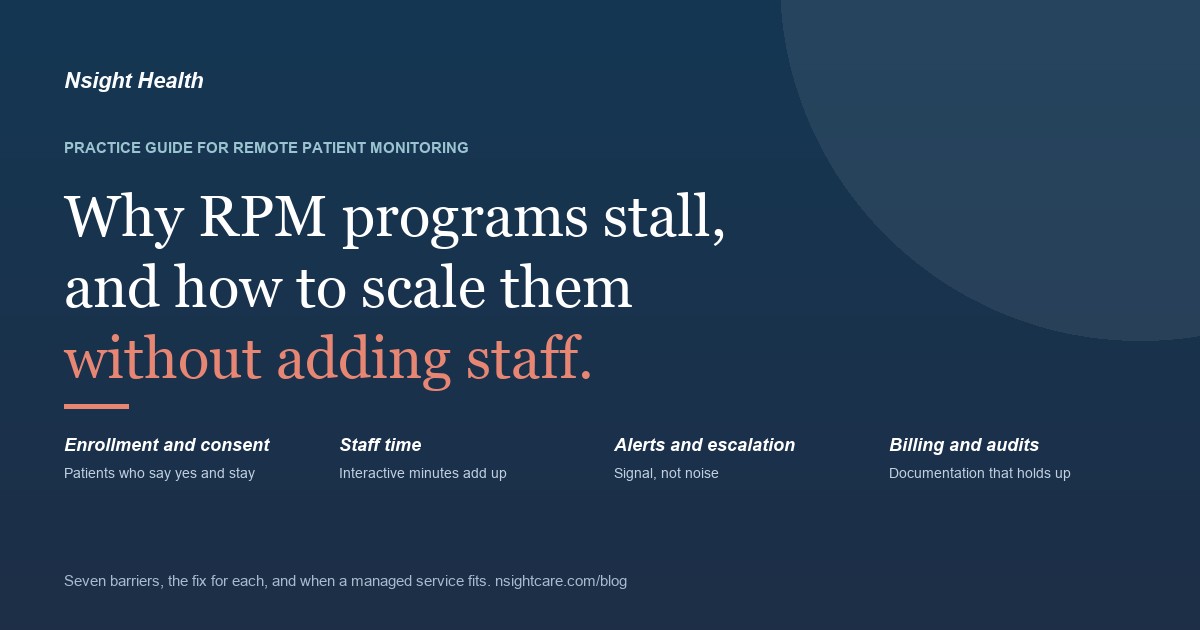
If your practice launched RPM with a handful of patients and watched it flatten out, you're in good company. Most stalled programs don't fail for one big reason. They fail on seven small ones that compound. This guide walks through each barrier, what it looks like on the ground and what fixes it. It also covers the 2027 CMS changes that affect how you plan, and how to decide between building the program yourself and bringing in a managed partner.
Key takeaways
- The seven barriers are enrollment and consent, device setup and adherence, the 16-day reading threshold, staff time for 99457 and 99458, alert fatigue and escalation, EHR workflow, and billing documentation.
- Staff time is the one that decides whether a program scales. Twenty documented minutes per patient per month adds up fast. Two hundred patients is roughly 67 hours of clinical time a month before any alert or enrollment call.
- Since January 1, 2026, CPT 99445 covers 2 to 15 days of device data, which softens the old 16-day cliff. It replaces 99454 in a period, it doesn't stack on it.
- From January 1, 2027, a new RPM patient needs an initiating visit. From January 1, 2029, CMS's employed-staff provision for RPM clinical staff takes effect, with CMS guidance promised first.
- A managed service makes sense when you don't have spare clinical staff. In-house makes sense when you do and want to own the whole workflow.
What makes implementing remote patient monitoring challenging for physicians?
The challenge is rarely the technology. A cellular blood pressure cuff or weight scale is simple. The hard part is everything around it: finding eligible patients, getting consent, keeping patients engaged, and making sure someone qualified reviews the data and documents what they did. Here is the short version before we go barrier by barrier.
| Barrier | What it looks like | What fixes it |
|---|---|---|
| Enrollment and consent | Eligible patients say no, never answer the phone or agree and never get a device | A physician recommendation, outreach in the patient's language, consent documented at the start |
| Device setup and adherence | Devices sit in a box, or readings stop after the first week | Cellular devices that need no Wi-Fi or smartphone, a first-week call, fast replacements |
| 16-day reading threshold | Patients land at 12 or 14 days of data and the device month goes unbilled | Mid-month tracking and outreach, plus the 2026 code 99445 for 2 to 15 days |
| Interactive minutes (99457, 99458) | Nobody has the 20 minutes per patient per month, so the management codes go unbilled | Automatic time tracking, scheduled touches, a dedicated clinical team |
| Alert fatigue and escalation | Too many alerts, unclear owners, slow response to the ones that matter | Tiered thresholds tuned per patient, written escalation protocols your physicians approve |
| EHR workflow | Readings live in a separate portal that clinicians have to remember to open | A live demo of what lands in the chart, before you sign anything |
| Billing documentation and audit risk | Time logs, orders and consent are scattered, and claims are exposed | One system that logs time, days of data and interactions, with a monthly billing report |
Why do eligible patients decline or never finish enrollment?
Enrollment is where most programs first stall. A patient who qualifies on paper still has to hear about the program, understand it, agree to it, receive a device and use it. Each step loses people. Our post on why eligible patients say no to RPM covers the conversation in detail. The short version: patients decline more often when the ask comes from an unfamiliar caller than from their own physician.
What fixes it.
- Have the physician or care team recommend the program at a visit. A recommendation from someone the patient trusts changes the call that follows.
- Run outreach in the languages your patients speak, and explain plainly what the device does, who watches the readings and what it costs the patient.
- Document consent at enrollment, not later. It's a billing requirement and a trust builder.
- Remember the 2027 change: for patients starting RPM on or after January 1, 2027, an initiating visit comes first. Any visit where remote monitoring is discussed and documented counts, so build the conversation into visits you already schedule (details below).
Why do patients stop taking readings after the first week?
A device that's hard to set up gets abandoned. A device that needs Wi-Fi, a tablet or Bluetooth pairing gets abandoned faster, especially among older patients. When readings stop, so does the data you need for billing and for care.
What fixes it.
- Choose cellular devices that send readings on their own, so the patient only has to take the measurement.
- Make someone responsible for a first-week call: did the device arrive, is it working, does the patient know when to use it?
- Handle shipping, troubleshooting and replacements outside the practice. If your front desk is the help line for broken cuffs, the program won't scale.
- Treat a quiet patient as a clinical signal and call, rather than waiting for the monthly report.
What is the 16-day rule in RPM billing, and why does it trip programs up?
For years, CPT 99454 (device supply and data transmission) required readings on 16 or more days in a 30-day period. A patient who transmitted on 14 days produced real clinical data and no billable device month. That cliff pushed practices to chase patients for readings at the end of the month and left a lot of legitimate monitoring unbilled.
Since January 1, 2026, CPT 99445 covers device supply and data transmission for 2 to 15 days in a period. You choose 99445 or 99454 for a given period, not both. Our guide to the 2026 RPM codes has the rates and documentation rules.
What fixes it.
- Track days of data mid-month, not at month end, so a patient who has gone quiet gets a call while there's still time.
- Let clinical need set the monitoring plan. A post-surgical patient who needs ten days of blood pressure checks shouldn't be pushed to day 16 to satisfy a code.
- Know which code applies before the claim goes out. A billing report that shows days of data per patient does this automatically.
How much staff time do RPM management codes (99457 and 99458) really take?
This is the barrier that decides whether a program scales. CPT 99457 covers the first 20 minutes of clinical monitoring time in a month, and 99458 covers each additional 20 minutes. The newer CPT 99470 covers the first 10 to 19 minutes, and you choose 99470 or 99457 in a period, not both. Treatment management requires at least one interactive communication with the patient or caregiver each month, and the time has to be documented.
Here is the arithmetic, as an illustration rather than a benchmark. At 20 minutes per patient per month, 200 patients is 4,000 minutes, or about 67 hours of documented clinical time a month. That's before enrollment calls, device troubleshooting or any alert that needs a second look. A practice that adds patients without adding clinical hours simply stops logging the time, and the management codes quietly go unbilled.
What fixes it.
- Use a platform that tracks clinical time automatically. Time kept on sticky notes doesn't survive an audit.
- Schedule routine monthly touches instead of waiting for alerts, so every patient gets the interactive communication.
- Give the work to a dedicated team. Reviewing RPM data between patient visits is the first thing to slip when the schedule is full.
- If you can't add clinical hours, this is the clearest sign a managed service fits.
How do you reduce alert fatigue and escalate the right readings?
A program with default thresholds on every patient produces a steady stream of alerts that mean little. Staff learn to ignore them, and then the one that matters gets missed. The opposite failure also happens: nobody knows who owns an out-of-range reading at 2 a.m., so it waits until morning.
What fixes it.
- Tier the alerts. Separate "note this trend" from "call this patient today" from "reach a physician now."
- Tune thresholds per patient. Your physician sets them. For heart failure, a common trigger is weight gain of more than 2 to 3 pounds in 24 hours or 5 pounds in a week, which is the guidance the American Heart Association gives patients, though the right number for any individual is a clinical call.
- Write the escalation protocol down. Who reviews, who calls the patient, who reaches the physician, and what the handoff note says.
- Cover nights and weekends. If a program only works during office hours, it only catches problems during office hours.
For heart failure in particular, see our guide to how RPM reduces hospital readmissions.
Why does EHR workflow make or break an RPM program?
If clinicians have to leave the chart and open another portal to see readings, they won't do it consistently. Programs that live outside the clinical workflow become something one staff member does when they have time. Our post on why EHR integration is essential for scaling remote care management programs goes deeper on this.
What fixes it. Ask any vendor for a live look at what a physician sees in your EHR, what it takes to switch it on and what it costs. Integration ranges from readings written into the chart to a document dropped in as a PDF, and the vendor's description of it doesn't always tell you which one you're getting.
What documentation do you need to survive an RPM audit?
RPM billing is under active scrutiny. In a September 2024 report, the HHS Office of Inspector General found that about 43 percent of Medicare enrollees who received RPM did not receive all three components of it, which raised questions about whether monitoring is being used as intended. OIG recommended that CMS add safeguards, require that RPM be ordered, and identify and monitor the companies that bill for it. Our posts on the OIG report and on what UPIC audit signals mean for your documentation cover this in depth.
What fixes it.
- Keep a physician order and documented consent on file for every enrolled patient.
- Log days of data, clinical minutes and each interactive communication in one place, per patient, per month.
- Make sure the medical necessity is clear in the chart, not only in the vendor's system.
- Remember the practice is the billing entity. A vendor can prepare the documentation and the monthly report, and your practice submits the claims and answers for them.
Not sure which of these seven is holding your program back? Schedule a demo and we'll walk through your numbers with you.
What does the 2027 CMS rule change for scaling RPM?
CMS's Calendar Year 2027 Physician Fee Schedule final rule (CMS-1848-F) takes effect January 1, 2027. These are the parts that affect how you scale. For the full breakdown, including what isn't changing, read our summary of the CMS 2027 final rule.
| Change | What the rule says | What it means for scaling |
|---|---|---|
| Initiating visit | From January 1, 2027, a new RPM or RTM patient needs an initiating visit, in person or by telehealth, where remote monitoring is discussed, before monitoring starts. The visit "does not have to be for the sole purpose of discussing remote monitoring services." | Build the RPM conversation into visits you already schedule. Patients already on monitoring before January 1, 2027 continue without a visit. |
| Employed-staff provision | From January 1, 2029, RPM and RTM codes can't be billed when the service isn't performed by clinical staff who are direct employees of the practitioner or practice. CMS will publish guidance on acceptable arrangements before then, and contracting with third-party companies is allowed through December 31, 2028. | Nothing changes through 2028. Ask any partner how its model works in 2029, and watch for the CMS guidance. The rule is about clinical-staff time; CMS said outside software, devices, connectivity and logistics remain allowed. |
| Payment | The treatment-management codes (99457, 99458) were not cut as proposed and move only with the overall conversion factor, about 2 percent. The device-supply code (99454) steps down by up to 19 percent in 2027, with a further step in 2028 subject to an AMA RUC review. | More of a monitored month's value now sits in documented clinical time. That makes the staff-time barrier above more important, not less. |
| CCM, PCM, BHI, APCM | Not changed by this rule. | Care-management programs sit alongside RPM and aren't affected by the initiating-visit or staffing provisions. |
Should you run RPM in-house or use a managed service?
This is the decision that determines whether a program scales. Neither answer is right for everyone. Our step-by-step guide to starting an RPM program covers launch, and our post on proactive chronic care in primary care without adding staff covers the care-management side. Here is how the choice looks for RPM specifically.
| Consideration | Run it in-house | Use a fully managed service |
|---|---|---|
| Clinical staffing | You hire or reassign nurses or medical assistants to review readings, call patients and log time | The vendor's clinical team does the monitoring and outreach, and escalates to your physicians |
| Speed to launch | Gated by hiring, training and workflow design | Faster, because the team, devices and billing reports already exist |
| After-hours coverage | You decide how to cover nights and weekends | Ask what coverage is included and who the reviewers work for |
| Control | Full control of the workflow, thresholds and patient relationship | Less day-to-day control, so protocols and reporting matter more |
| 2029 employed-staff provision | Your own employees already fit the direction CMS is heading | Depends on CMS's coming guidance; ask the partner for its plan |
| Best fit | Practices with employed care-management staff and spare capacity | Practices that want RPM without adding clinical headcount |
A good rule of thumb: if the practice can name the person who will spend 67 hours a month on 200 patients, in-house can work. If it can't, a managed service is usually the faster route to a program that holds up. Either way, pick based on who will do the monthly clinical work, not on the feature list.
How do you know if your RPM program has stalled?
Look at five numbers every month. If any is drifting the wrong way, you've found the barrier to fix first.
- Enrollment conversion: of eligible patients contacted, how many consent and receive a device?
- Active patients: of enrolled patients, how many transmitted readings this month?
- Days of data: how many patients are sitting just short of a billing threshold at mid-month?
- Clinical minutes per patient: are you logging the interactive communication for every patient?
- Time to action: how long does an out-of-range reading wait before someone acts on it?
How does Nsight run these pieces for a practice?
Nsight Health is a fully managed RPM provider. It runs the program for the practice using its own clinical team and infrastructure. Here is how that maps to the barriers above, based on what's published on nsightcare.com:
- Enrollment and consent. Multilingual outreach, education, consent and onboarding on the practice's behalf.
- Devices and adherence. FDA-cleared, cellular-enabled blood pressure monitors, weight scales, pulse oximeters, glucometers and spirometers. Patients don't need Wi-Fi, Bluetooth pairing or a smartphone. Nsight provides the first device for each patient and includes consumables, and it handles shipping, troubleshooting and replacements. See the devices page.
- Clinical time and escalation. A U.S.-based clinical team, including W2 registered nurses, LVNs and medical assistants, reviews patient data around the clock (24/7/365 clinical review by licensed staff) and escalates using provider-approved protocols.
- EHR workflow. Connections to more than 50 EHRs.
- Billing and audit readiness. The platform tracks clinical time automatically, documents patient interactions and generates monthly billing reports. Fees are tied to successful reimbursement, with no upfront cost to the practice. The practice remains the billing entity.
- Compliance. HIPAA and SOC 2 Type II compliant.
- Launch. A turnkey program can often launch within 30 to 60 days, depending on EHR setup, device logistics and patient enrollment.
On the clinical side, in one Nsight cohort of 97 heart failure patients monitored with a remote weight scale, critical fluid-gain alerts (a gain of 3 lbs in a day or 5 lbs in a week) fell from 18.1% to 5.15% between September and December, a 72% decrease. It's a small cohort, it measures alerts rather than hospital admissions, and individual results vary.
Who Nsight isn't the right fit for. If you already employ staff with the capacity to review every reading daily and you want to own the whole workflow, a software-only platform may suit you better. For the 2027 rule and what it means for your patients, see the White Coat Guide to RPM and CCM in 2027. To see how a program would run for your panel, schedule a demo.
Frequently asked questions
What makes implementing remote patient monitoring challenging for physicians?
The technology is the easy part. The challenge is the ongoing clinical work around it: enrolling patients and getting consent, keeping them taking readings, reviewing data daily, logging interactive time for CPT 99457 and 99458, escalating alerts and documenting everything for billing. That work lands on staff who are already busy, which is why programs plateau.
Why do clinics struggle to scale remote patient monitoring services?
Because every added patient adds monthly clinical work, and most practices don't add clinical hours at the same pace. At 20 minutes per patient per month, 200 patients needs about 67 hours of documented time. When capacity runs out, patients stop getting calls, time stops being logged and the program flattens.
How can a practice scale RPM without hiring more staff?
Move the repeatable tasks off the clinical team: automatic time tracking, scheduled monthly touches, tiered alerts with written escalation protocols and outsourced device logistics. If the practice has no spare clinical capacity, a fully managed service supplies the clinical team, devices and billing reports so the program is run for you.
What is the 16-day rule in RPM billing?
CPT 99454 requires device readings on 16 or more days in a 30-day period. Since January 1, 2026, CPT 99445 covers 2 to 15 days. You choose 99445 or 99454 for a period, not both. Confirm current requirements with CMS and your billing team.
How much staff time does RPM take per patient?
CPT 99457 requires the first 20 minutes of clinical monitoring time in a month, with at least one interactive communication, and 99458 covers each additional 20 minutes. The newer 99470 covers 10 to 19 minutes, and you choose 99470 or 99457 in a period. Actual time per patient varies with how many alerts a patient generates.
How do you reduce alert fatigue in RPM?
Tier alerts by urgency, set thresholds per patient with your physician and write down who reviews, who calls and who escalates. For heart failure, the American Heart Association tells patients to check in with their care team after a gain of more than 2 to 3 pounds in a day or 5 pounds in a week, though your physician sets the right trigger for each patient.
Is it better to run RPM in-house or use a managed service?
In-house works when you employ clinical staff with spare capacity and want full control of the workflow. A managed service works when you don't have that capacity or want to launch faster. Ask any managed partner who reviews readings overnight, who those clinicians work for and how its model works in 2029.
Will the 2027 CMS rule affect how I scale RPM?
Yes, in two ways. From January 1, 2027, new RPM patients need an initiating visit, and patients already on monitoring continue without one. From January 1, 2029, RPM and RTM codes can't be billed when the service isn't performed by clinical staff who are direct employees of the practice, and CMS will publish guidance on acceptable arrangements first. Contracting with third-party companies is allowed through December 31, 2028.
Does the practice or the vendor bill Medicare for RPM?
The practice stays the billing entity. A vendor helps run the program and prepares the documentation and monthly billing report, and your practice submits the claims.
How long does it take to launch RPM with a managed partner?
A turnkey program can often launch within 30 to 60 days, depending on EHR setup, device logistics and patient enrollment.
Sources
Nsight Health, "The CMS 2027 Physician Fee Schedule final rule: what changes for remote patient monitoring, what doesn't, and what to do," nsightcare.com/blog/cms-2027-final-rule/ (quoting CMS-1848-F, Federal Register public inspection document 2026-22743).
Nsight Health, "New RPM CPT Codes 2026: 99445 and 99470," nsightcare.com/blog/new-rpm-cpt-codes-2026-guide-99445-99470-reimbursement/.
HHS Office of Inspector General, "Additional Oversight of Remote Patient Monitoring in Medicare Is Needed" (OEI-02-23-00260), September 2024, oig.hhs.gov/reports/all/2024/additional-oversight-of-remote-patient-monitoring-in-medicare-is-needed/.
American Heart Association, "Managing Heart Failure Symptoms," heart.org/en/health-topics/heart-failure/warning-signs-of-heart-failure/managing-heart-failure-symptoms.
Nsight Health, Remote Patient Monitoring and Devices pages, nsightcare.com.
Disclaimer: This article is provided for general informational purposes only and does not constitute legal, billing, clinical or financial advice. Coverage rules, supervision requirements and reimbursement policies change and vary by Medicare Administrative Contractor (MAC) and payer. Providers are responsible for verifying current requirements and confirming the accuracy of any claims they submit. Outcomes are based on aggregated Nsight program data; individual results vary. The 67-hour figure is arithmetic for illustration, not a staffing benchmark. CPT is a registered trademark of the American Medical Association.