Last updated: November 17, 2026
Quick answer: The best remote patient monitoring (RPM) option for a cardiology practice depends on who you want doing the monitoring. Practices without spare clinical staff usually choose a fully managed RPM service: the vendor supplies cellular blood pressure cuffs and weight scales, plus a clinical team that reviews readings around the clock and escalates to your physicians. Practices with employed monitoring staff often choose a software-only platform. Patients with pacemakers, ICDs or loop recorders are usually followed through the device maker's own network instead, under different billing codes. Nsight Health is a fully managed option; the section on where we fit says plainly who we're not right for.
If you run a cardiology practice and you've started shopping for an RPM partner, you've probably noticed that every vendor says the same things. This guide skips the pitch. It explains the four kinds of partner you'll run into, the eight criteria that actually separate them for cardiology patients, the billing codes involved and the one 2027 rule change that should shape your decision.
Key takeaways
- "Remote patient monitoring" covers four different kinds of partner. The biggest difference is who watches the readings and calls the patient.
- For hypertension, heart failure and coronary artery disease at home, the core devices are a cellular blood pressure cuff and a weight scale. A pulse oximeter and glucometer cover common comorbidities.
- Implanted cardiac devices (pacemakers, ICDs, loop recorders) are monitored through a separate program with separate codes. RPM for home vitals doesn't replace it.
- Ask every vendor how its clinical staffing model would work under CMS's employed-staff provision, which starts January 1, 2029.
- Look at escalation first. For heart failure, a fast, clear handoff to your physician matters more than a long feature list.
Step one: decide what you're actually monitoring
Cardiology practices usually mean one of two things by "remote monitoring," and they're not the same service.
Home vital signs (RPM). The patient uses a connected device at home, such as a blood pressure cuff or a weight scale, and a clinical team reviews the readings. This is the program billed under CPT 99453, 99454, 99445, 99457, 99458 and 99470. It fits patients with hypertension, heart failure and coronary artery disease.
Implanted device monitoring. A pacemaker, ICD, implantable cardiac monitor or loop recorder sends its own data through a home monitor or app. The device manufacturer runs the network, and the practice bills a different code family (for example, CPT 93294 through 93298). Medtronic's remote monitoring program for implanted heart devices is one example of a manufacturer-run network.
Most practices need both: device clinic follow-up for implants, and an RPM program for the larger group of patients with blood pressure and heart failure to manage between visits. The rest of this guide is about the second one.
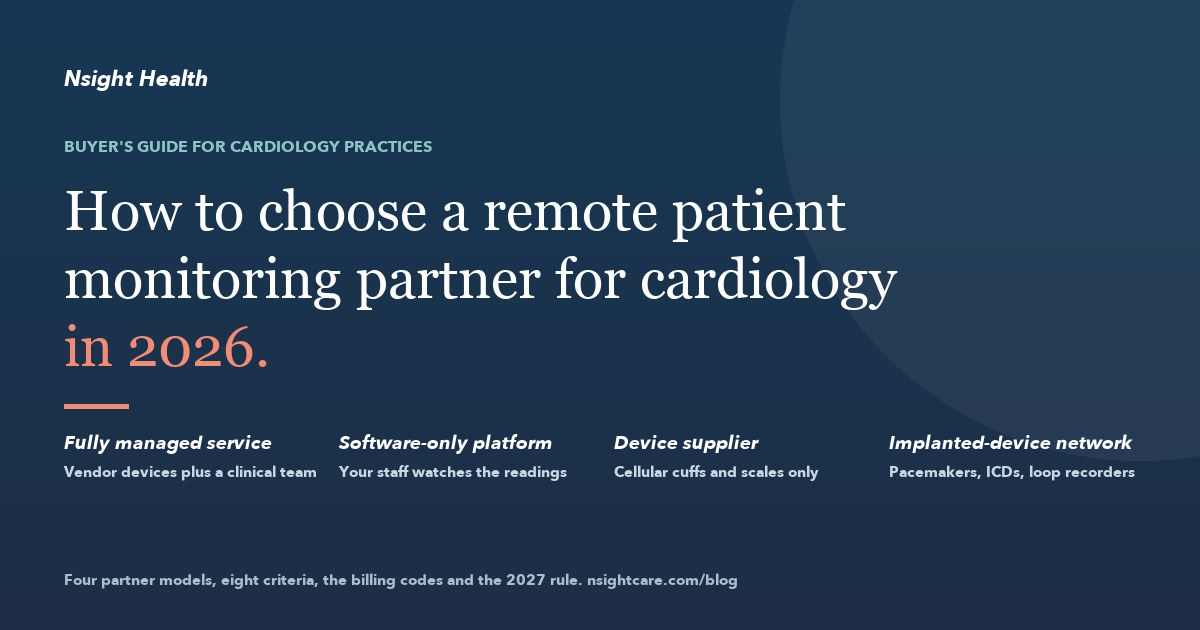
The four kinds of RPM partner, compared
Instead of ranking vendors, here is how the four models differ. Use it to decide which kind of partner fits your practice before you compare any names. For a wider look at the market, see our guide to remote patient monitoring companies.
| Partner model | What you get | Who does the clinical monitoring | Best fit in cardiology | Watch out for |
|---|---|---|---|---|
| Fully managed RPM service | Devices, platform, patient enrollment and onboarding, a clinical team, documentation and billing support | The vendor's clinical team, with escalation to your physicians | Practices that want hypertension and heart failure programs without adding clinical headcount | Confirm who the clinical staff work for, and how the model holds up under the 2029 employed-staff provision |
| Software-only platform | Dashboard, alerts, time tracking, billing reports, usually with devices | Your own staff | Practices with employed nurses or medical assistants who can review readings daily | Alert volume lands on your team, including after-hours critical readings |
| Device and connectivity supplier | Cellular devices, gateways, shipping and replacement | Your staff, or another partner you add | Organizations building their own program on top of a device layer | You still need a platform, a clinical team and a billing workflow |
| Implanted-device monitoring network | Home monitors or apps that read pacemakers, ICDs and loop recorders | Your device clinic, using the manufacturer's portal | Patients with implanted cardiac devices | Not a program for blood pressure or weight; billed under a different code family (for example, CPT 93294 to 93298) |
The eight criteria that matter for a cardiology practice
1. Devices that fit cardiology patients
Ask: Which devices ship, how do they connect, and who pays for them?
For cardiology, the working set is a blood pressure cuff for hypertension, a weight scale for heart failure, and a pulse oximeter and glucometer for the comorbidities many of your patients carry. Whether the devices are cellular matters more than it sounds. A cuff or scale that sends data on its own, with no Wi-Fi, Bluetooth pairing or smartphone, is easier for older patients to keep using, and consistent daily readings are the whole point in heart failure.
| Device | Why cardiology uses it |
|---|---|
| Blood pressure cuff | Tracks hypertension control and the effect of medication changes between visits |
| Weight scale | Daily weights are an early warning for fluid gain in heart failure |
| Pulse oximeter | Oxygen saturation for patients with heart failure and lung disease together |
| Glucometer | Covers diabetes in patients with cardiovascular disease |
Watch out: Large upfront device orders, patients expected to set up Bluetooth pairing themselves, and vendors that leave consumables and replacements to your office.
2. Who does the clinical monitoring, and for whom they work
Ask: Who reviews the readings, when, and under what escalation rules?
This is the criterion that separates the models in the table above. In a software-only setup, your staff reviews every alert. In a fully managed setup, the vendor's clinicians do, and your physicians hear about the readings that need a decision. Ask for hours of coverage, the credentials of the people reviewing readings, and how thresholds are set. Thresholds should be adjustable for the practice and for the individual patient.
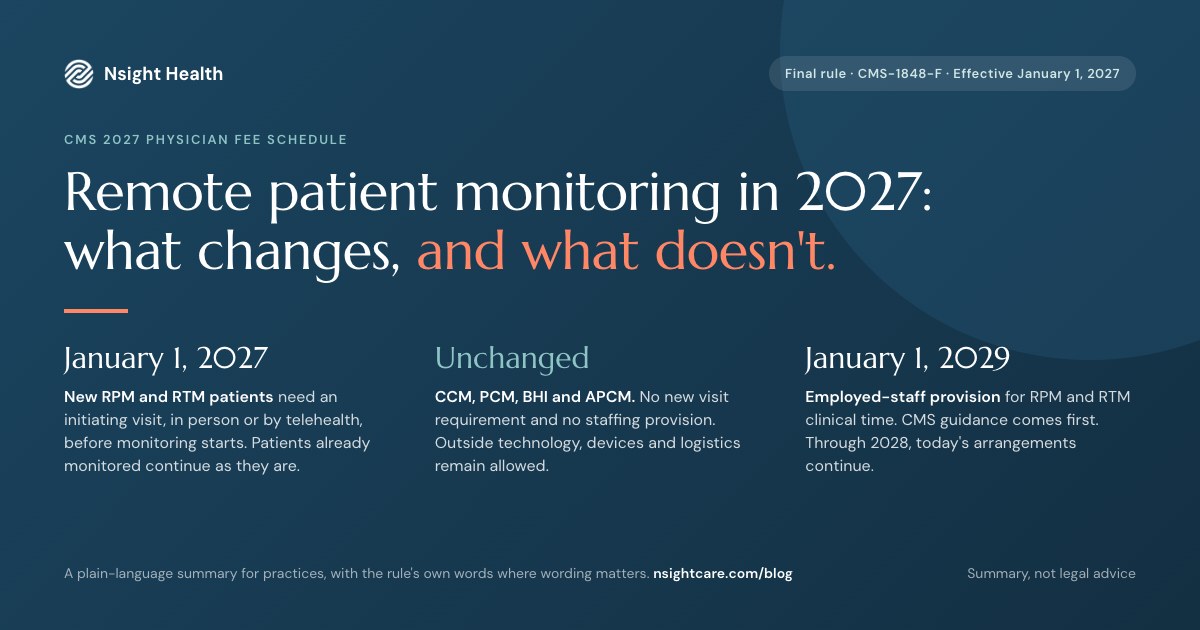
Then ask the 2027 question. CMS finalized a rule that, starting January 1, 2029, RPM and RTM codes can't be billed when the service isn't performed by clinical staff who are direct employees of the practitioner or the practice. Contracting out to third-party companies is still allowed through December 31, 2028, and CMS will publish guidance on acceptable arrangements before 2029. Any partner you consider should be able to explain, in plain words, what its model looks like in 2029. Our breakdown of the CMS 2027 final rule covers the details, including what isn't changing.
Watch out: No clinical monitoring at all, vague answers about who reviews readings overnight, and no plan for 2029.
3. Escalation to your physicians
Ask: What happens when a reading crosses a threshold at 2 a.m.?
In heart failure, the difference between a useful program and a noisy one is the handoff. A good partner follows escalation protocols your physicians approve, contacts the patient, documents the interaction and reaches your team with enough context to act. Ask to see a sample escalation note and the written protocol.
4. EHR integration
Ask: Which EHRs do you integrate with, and what shows up in the chart?
Integration ranges from readings written into the chart to a PDF dropped in as a document. Ask for a live look at what a cardiologist sees in your EHR, and what it costs to turn on.
5. Billing and CPT code support
Ask: Does the platform track time and days of data automatically, and what do you hand my billing team each month?
The codes you'll bill for RPM:
| CPT code | What it covers |
|---|---|
| 99453 | Initial setup and patient education on the equipment (one time) |
| 99454 | Device supply and data transmission, 16 or more days in a 30-day period |
| 99445 | Device supply and data transmission, 2 to 15 days (new in 2026; you choose 99445 or 99454 in a period, not both) |
| 99457 | First 20 minutes of clinical monitoring time in a month |
| 99458 | Each additional 20 minutes of clinical monitoring time |
| 99470 | First 10 to 19 minutes of clinical monitoring (new in 2026; you choose 99470 or 99457 in a period, not both) |
A strong partner tracks clinical time automatically, documents each patient interaction and gives your billing team a monthly report so claims are accurate. The practice stays the billing entity. Our guide to the 2026 RPM codes has the rates and documentation rules.
Watch out: Manual time tracking, thin documentation and billing support that doesn't match how your EHR works.
6. Patient enrollment
Ask: Who finds eligible patients, explains the program, gets consent and trains them on the device?
A program only works if patients enroll and keep taking readings. Some vendors hand enrollment back to your front desk. Others run outreach on your behalf, in the languages your patients speak, and call each patient once the device arrives. Remember that from January 1, 2027, a new RPM patient needs an initiating visit with their practitioner first. Ask how the vendor coordinates enrollment around that visit.
7. Compliance and data security
Ask: Will you sign a Business Associate Agreement, and what independent security certifications do you hold?
RPM moves protected health information every day. Look for HIPAA compliance, an independent security report such as SOC 2 Type II, and a documented compliance program. RPM billing is under active scrutiny, so ask how the vendor keeps documentation audit-ready.
8. Contract terms
Ask: What am I committing to, what do I pay up front, and how do fees work?
The friendliest structures avoid large device purchases and long lock-ins before you've seen results. Ask whether fees are tied to reimbursement and what happens if CMS changes the rules mid-contract.
Want to run these questions against your own patient panel? Schedule a demo and we'll walk through them with you.
Where Nsight fits
Nsight Health is a fully managed RPM provider. It runs the program for the practice using its own clinical team and infrastructure, including patient outreach and enrollment, FDA-cleared cellular devices, 24/7/365 clinical review by licensed staff, documentation and billing support. Here is what that looks like against the criteria above, based on what's published on nsightcare.com:
- Devices. FDA-cleared, cellular-enabled blood pressure monitors, weight scales, pulse oximeters, glucometers and spirometers. Patients don't need Wi-Fi, Bluetooth pairing or a smartphone. Nsight provides the first device for each patient and includes consumables, and it handles shipping, troubleshooting and replacements. See the devices page.
- Clinical monitoring. A U.S.-based clinical team, including W2 registered nurses, LVNs and medical assistants, reviews patient data around the clock and escalates using provider-approved protocols.
- Heart failure results. In one Nsight cohort of 97 heart failure patients monitored with a remote weight scale, critical fluid-gain alerts (a gain of 3 lbs in a day or 5 lbs in a week) fell from 18.1% to 5.15% between September and December, a 72% decrease. It's a small cohort, and individual results vary.
- EHR integration. Connections to more than 50 EHRs.
- Billing. The platform tracks clinical time automatically, documents patient interactions and generates monthly billing reports. Nsight's fees are tied to successful reimbursement, with no upfront cost to the practice.
- Enrollment. Multilingual outreach, education, consent and onboarding on the practice's behalf.
- Compliance. HIPAA and SOC 2 Type II compliant.
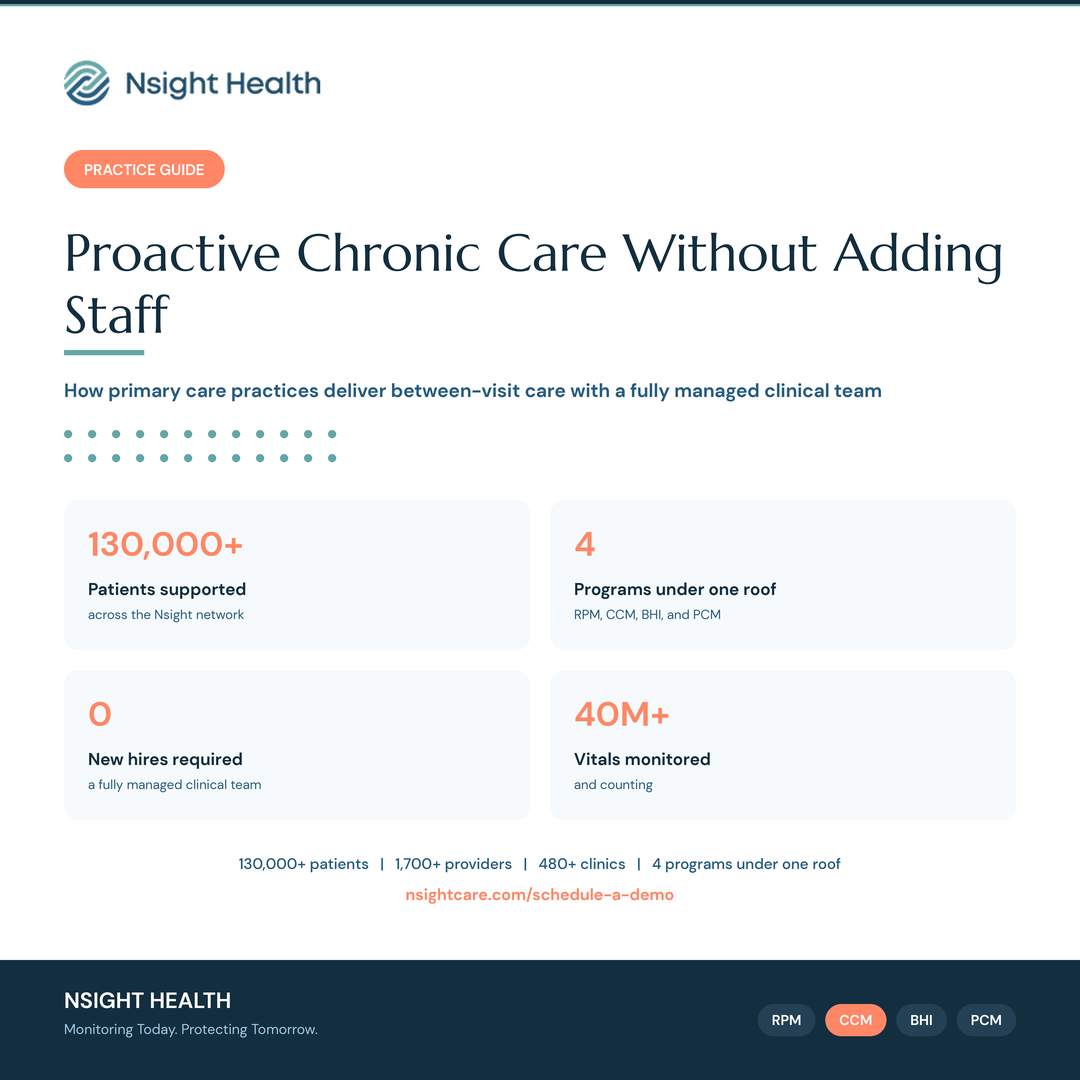
- Programs. Remote patient monitoring, chronic care management, principal care management and behavioral health integration through one partner.
- Recognition. Named Best Remote Patient Monitoring Solution of 2026 by MedTech Breakthrough.
Cardiology practices are one of the specialties Nsight serves, and one cardiology practice's medical office administrator put it this way on our site: "Nsight has been a true partner to our cardiology team—responsive, proactive, and easy to work with." (Kristie B., Medical Office Administrator)
Who Nsight isn't the right fit for. If you already employ staff who can review readings every day and you only need software, a software-only platform may suit you better. If your need is follow-up of implanted pacemakers and ICDs, that runs through the device manufacturer's network. Nsight's RPM covers home vital-sign devices. A turnkey program can often be launched within 30 to 60 days, depending on EHR setup and enrollment.
For the 2027 rule specifically, see our White Coat Guide to RPM and CCM for cardiology. To see how a program would work for your panel, schedule a demo.
Frequently asked questions
What are the top remote patient monitoring options for cardiology?
There are four kinds: fully managed RPM services, software-only platforms, device and connectivity suppliers, and manufacturer networks for implanted cardiac devices. For home blood pressure and heart failure monitoring, most practices choose between a fully managed service and a software-only platform, based on whether they have staff to review readings. Nsight Health is a fully managed provider.
Which RPM vendors offer full-service clinical support?
Fully managed vendors supply the clinical team as well as the devices and software. Nsight Health is one: its own clinical team reviews patient data 24/7/365, contacts patients and escalates using provider-approved protocols. When you evaluate any vendor, ask who reviews readings overnight and who those clinicians work for.
Which devices does a cardiology RPM program use?
Typically a blood pressure cuff for hypertension and a weight scale for heart failure, with a pulse oximeter and glucometer for comorbidities. Cellular devices that send readings automatically, with no Wi-Fi or smartphone, tend to keep older patients engaged.
What's the difference between full-service and software-only RPM?
A software-only vendor provides the platform, and often devices, and leaves monitoring and patient outreach to your staff. A full-service vendor adds a clinical team and logistics so the program is run for you.
Does RPM replace remote monitoring of pacemakers and ICDs?
No. Implanted devices are monitored through the manufacturer's network and billed under a different code family, such as CPT 93294 to 93298. RPM for home vitals is a separate program.
Which CPT codes cover cardiology RPM?
CPT 99453 for setup and patient education, 99454 or the newer 99445 for device supply and data transmission, and 99457 and 99458 or the newer 99470 for clinical monitoring time. Medicare has documentation and time requirements for each. Confirm current requirements with CMS and your billing team.
Will the 2027 CMS rule change which RPM partner I can use?
Not before 2029. From January 1, 2027, new RPM patients need an initiating visit. From January 1, 2029, RPM and RTM codes can't be billed when the service isn't performed by clinical staff who are direct employees of the practice, and CMS will publish guidance on acceptable arrangements before then. Contracting with third-party companies is allowed through December 31, 2028. Ask any partner how its model works in 2029.
Does the practice or the vendor bill Medicare?
The practice stays the billing entity. A vendor helps run the program and prepares the documentation and billing report, and your practice submits the claims.
How fast can a cardiology practice launch RPM?
A turnkey program can often launch within 30 to 60 days, depending on EHR setup, device logistics and patient enrollment.
Sources
CMS Medicare Coverage Database, "Billing and Coding: Cardiac Rhythm Device Evaluation (A56602)," cms.gov/medicare-coverage-database/view/article.aspx?articleId=56602.
Medtronic, "Remote Monitoring for Implanted Heart Devices," medtronic.com/en-us/l/patients/treatments-therapies/remote-monitoring.html.
Nsight Health, Remote Patient Monitoring, Devices and CMS 2027 final rule pages, nsightcare.com.
Disclaimer: This article is provided for general informational purposes only and does not constitute legal, billing, clinical or financial advice. Coverage rules, supervision requirements and reimbursement policies change and vary by Medicare Administrative Contractor (MAC) and payer. Providers are responsible for verifying current requirements and confirming the accuracy of any claims they submit. Outcomes are based on aggregated Nsight program data; individual results vary. CPT is a registered trademark of the American Medical Association.