
As the healthcare industry continues to shift toward value-based care (VBC), a provider payment model based on patient health outcomes rather than the number of services rendered, providers are increasingly adopting remote patient monitoring (RPM) to enhance care delivery and promote financial stability. With anticipated changes in insurance and Medicare/Medicaid reimbursement models in 2026, RPM emerges as a strategic tool to help providers adapt and potentially prevent revenue loss.
Key Takeaways
- Practices are adopting RPM to support care delivery and financial stability as the market grows rapidly.
- Value-based care rewards providers for outcomes rather than volume, and RPM supports the outcomes VBC measures.
- Anticipated 2026 to 2027 reimbursement changes could reduce revenue for practices that do not adapt.
- CMS aims for most Medicare beneficiaries to be in accountable care relationships, making proactive monitoring increasingly important.
The Financial Imperative for RPM
The RPM market is experiencing significant growth globally. It’s projected to reach $207.5 billion by 2028, up from $71.9 billion in 2023, reflecting a compound annual growth rate (CAGR) of $23.6%. In the U.S., the value of the RPM market in 2023 was $24.39 billion, expected to grow to $56.94 billion by 2030. Several factors are driving this growth:
- Chronic disease management: RPM is compatible with chronic care management by effectively facilitating continuous health monitoring. The prevalence of chronic conditions, which affect nearly 60% of Americans, means providers need practical solutions for meeting the VBC requirements of this growing patient segment.
- Technological advancements: Wearable device innovations and artificial intelligence (AI) analytics enhance RPM capabilities and adoption.
- Policy support: Government initiatives, such as the Federal Communications Commission’s (FCC’s) COVID-19 Telehealth Program implemented in 2020, improved infrastructure, making RPM more accessible. This program ended in March 2025, but it assisted in paving the way for today’s ongoing telehealth flexibilities.
RPM’s Role in Value-Based Care (VBC)
VBC models reward providers for patient health outcomes instead of the traditional fee-for-service model. They focus on prevention and team-based care, intending to help patients get healthier, avoid chronic disease complications and hospital readmissions, and reduce overall costs. RPM aligns with these objectives by enabling the following:
- Proactive care: Continuous monitoring enables consistent tracking of vitals, anomalies, and negative health trends, promoting early intervention and decreased hospital admissions.
- Patient engagement: Patients become active participants in their health management, leading to better adherence and outcomes.
- Data-driven decisions: Real-time data supports informed clinical decision-making, enhancing the quality of care.
To illustrate, Dr. Zsolt Kulcsar, system medical director at Lee Health/Virtual Health, based in Fort Myers, Florida, said about RPM, "When the technology was applied to southwest Florida patients, we saw an overall reduction of 30-day readmission rates for all clinical pathways by 50%."
Preparing for 2026 and Beyond
Changes in reimbursement models in the coming years could lead to revenue declines if providers don’t adapt. Providers will receive lower payments following the previous healthcare model. RPM becomes important because it supports VBC by improving outcomes and creates new reimbursable services like billing Medicare for remotely monitoring a patient’s vitals. Leveraging RPM, providers can accomplish the following:
- Diversify revenue streams: RPM offers alternative income sources, reducing reliance on traditional fee-for-service models. For example, by enrolling 100 high-risk patients in an RPM program with a wearable device, collecting at least 16 days of health data per month, and reviewing that data for at least 20 minutes monthly, providers can bill $120-$150 per patient per month under current Medicare codes.
- Enhance operational efficiency: RPM reduces the need for in-person visits, optimizing resource utilization of clinical space and staff time spent on patient intake, vital checking, and room prep. It also helps to balance provider workload, reduce operational costs, and promote scheduling flexibility.
- Improve patient outcomes: Continuous monitoring as part of an RPM program leads to early detection and intervention, enhancing patient health and satisfaction.
Moreover, AI and machine learning integration with RPM systems is expected to improve predictive analytics and personalized care, aligning with the goals of VBC models.
Upcoming Changes to Reimbursement Models by 2026-2027
The Centers for Medicare and Medicaid Services (CMS) have announced their goals for most Medicare beneficiaries to be aligned with a VBC model by 2030. Highlights of the programs and payment structures being reshaped between now and 2027 include:
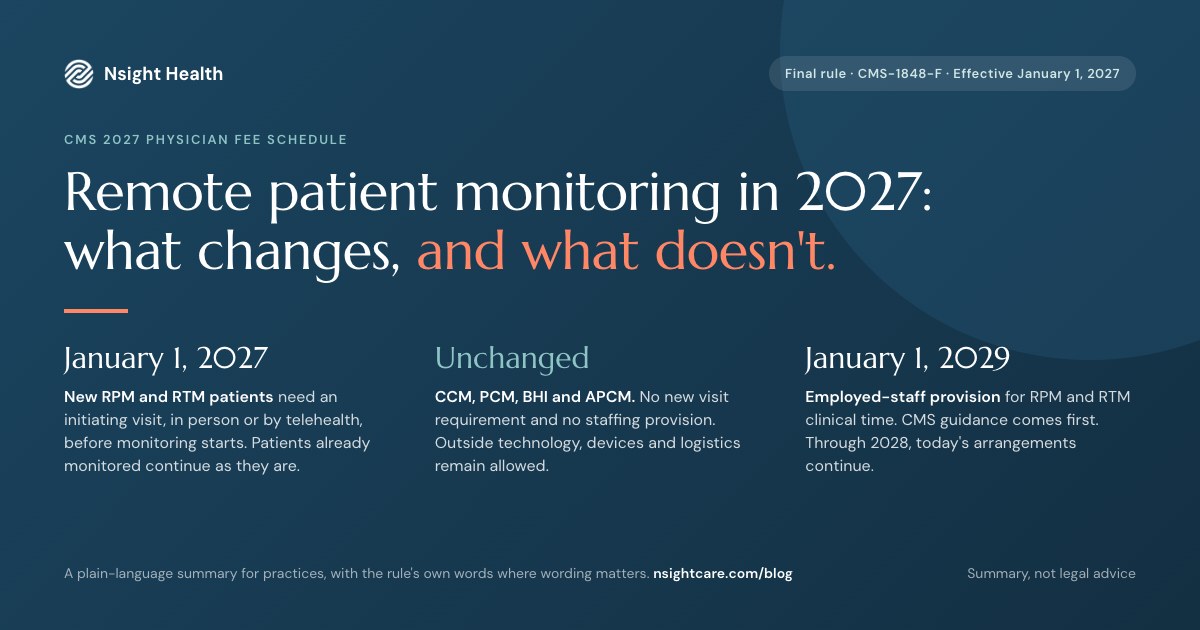
- Increased MIPS (Merit-based Incentive Payment System) penalties: Providers who continue to engage primarily with fee-for-service billing without engaging in value-based programs will face higher financial penalties under MIPS scoring adjustments.
- Expansion of APMs (Alternative Payment Models): CMS is pushing for broader adoption of Advanced APMs like bundled payments, Comprehensive Primary Care Plus (CPC+), and Direct Contracting, which tie a substantial portion of provider reimbursement to quality measures, patient satisfaction, and cost control.
- Reduced fee-for-service updates: Annual payment updates for traditional fee-for-service billing will likely lag behind inflation rates, lowering revenue for providers who have not transitioned to the new care model.
- Mandatory participation pilots: New pilots are mandatory for certain providers, such as the ACO REACH model, which requires them to take on financial risk related to patient outcomes.
- Private payers follow suit: Large insurers like United Healthcare, Aetna, and Cigna are expanding their VBC contracts, reducing opportunities for fee-for-service billing even outside of Medicare.
These changes mean that RPM and other digital health solutions will be essential not just for clinical care improvements, but also for financial viability in a value-first healthcare economy.
As healthcare evolves from a “paying for doing” to a “paying for results” system, RPM can become a valuable part of the transition. Through RPM adoption, providers can improve patient outcomes, streamline operations, reduce costs, and safeguard their financial health against potential revenue declines post-2026. Investing in RPM today positions healthcare providers for a more resilient and patient-centered future.
To learn more about RPM devices and CCM through Nsight, click HERE to schedule a demo today. Whether you are a patient or provider looking to learn more about RPM, we would love to hear from you.